


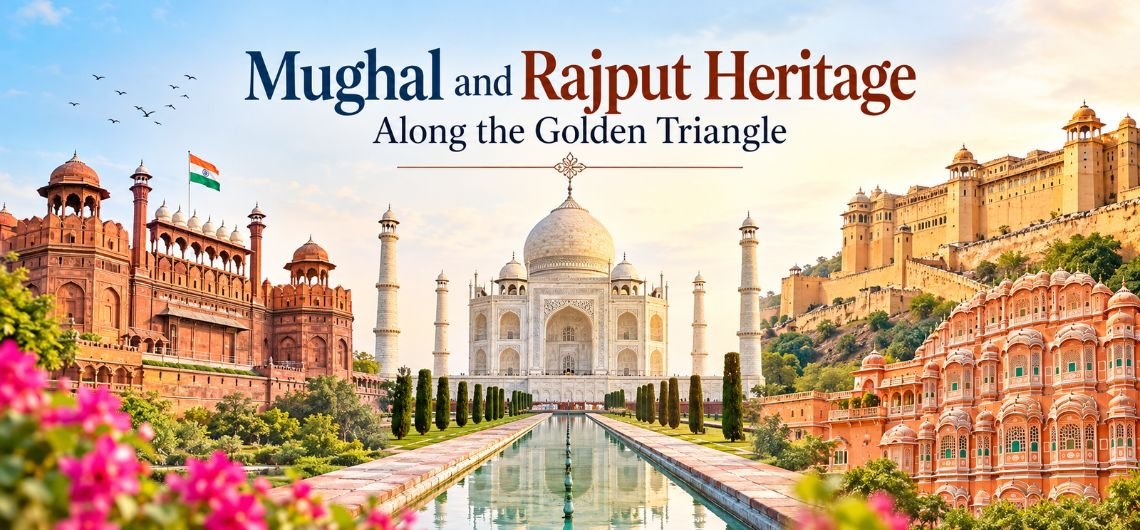
Few journeys in India fit so much history into so short a distance. Delhi, Agra and Jaipur, the three cities of the Golden Triangle route, hold some of the subcontinent’s most celebrated tombs, forts, palaces and gardens. Seen together, they tell the story of Mughal and Rajput heritage along the Golden Triangle: two powerful traditions that competed, cooperated and borrowed from each other for centuries.
In Delhi and Agra, red sandstone and white marble speak of imperial ambition. In Jaipur, hilltop ramparts, painted courtyards and latticed balconies reflect the court culture of the Rajput kings. This guide explains what to look for at each stop, how the two architectural languages differ, and how to plan a visit that goes beyond the postcard views.
Understanding the Mughal and Rajput Legacy in Northern India
The Mughal Empire began in 1526, when Babur defeated the Delhi Sultanate at Panipat, and it remained a major power into the 18th century. Its rulers brought Persian and Central Asian traditions into contact with Indian craftsmanship, producing monumental tombs, mosques, forts and charbagh (four-part) gardens.
The Rajput kingdoms, among them Mewar, Marwar and Amber (the predecessor of Jaipur), were older regional powers with their own clans, courts and military traditions. Their architecture centred on hilltop forts, palace complexes and temples built in local stone.
Their relationship was never one continuous rivalry. Some Rajput rulers resisted Mughal expansion, as Mewar did at the Battle of Haldighati in 1576. Others, notably the Kachhwaha rulers of Amber, formed marriage and service alliances and held senior roles in Mughal armies and administration. UNESCO notes that Amber Palace reflects a common Rajput–Mughal court style that developed in the 17th century.
On the Golden Triangle, Delhi shows Mughal power at its political centre, Agra shows its artistic peak, and Jaipur shows a Rajput court tradition that was itself shaped by Mughal contact.
Delhi — Exploring the Grandeur of Mughal Architecture
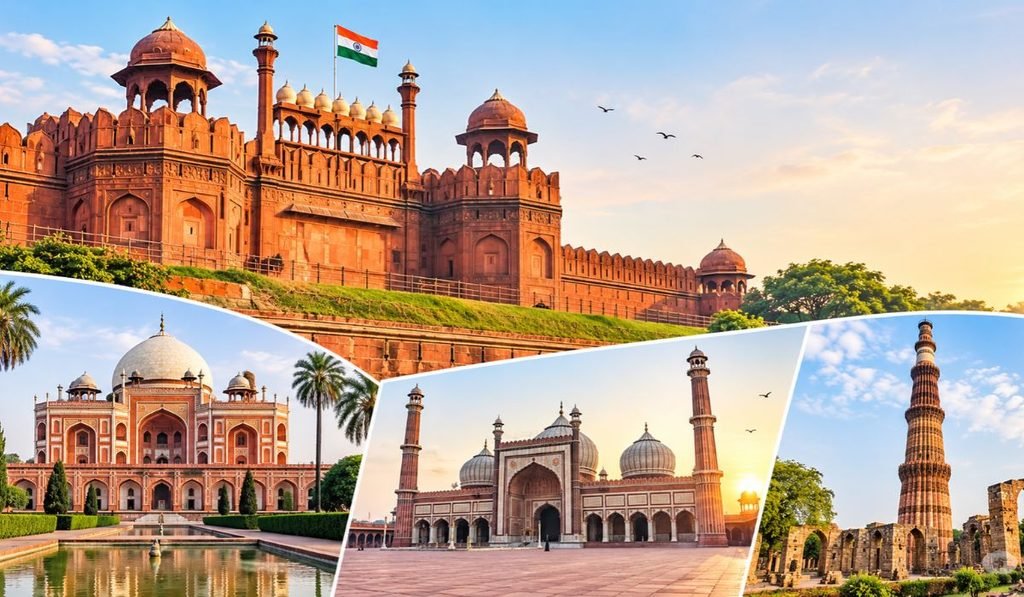
Red Fort. Shah Jahan built the Red Fort as the palace-citadel of his new capital, Shahjahanabad, between 1639 and 1648. Its massive red sandstone walls enclose audience halls, pavilions and gardens, and the complex is part of the UNESCO-listed Red Fort Complex (2007). It is a strong example of how Mughal planning expressed imperial authority through scale, symmetry and ceremony.
Humayun’s Tomb. Commissioned in the 1560s by Humayun’s widow, Bega Begum, this tomb is widely seen as a forerunner of the Taj Mahal. Its red sandstone and white marble, double dome and large charbagh garden established a template for later Mughal garden tombs. It was inscribed by UNESCO in 1993.
Jama Masjid. Completed in 1656 under Shah Jahan, this is one of India’s largest mosques. Red sandstone and white marble bands, three monumental gateways and a vast courtyard show how Mughal architecture served religious life as well as imperial display.
Old Delhi and beyond. The lanes around Chandni Chowk, laid out under Shah Jahan, still follow the logic of the Mughal city. For an earlier layer, Qutb Minar belongs to the Delhi Sultanate period, while Safdarjung’s Tomb (1754) shows the late Mughal garden-tomb tradition.
Travelers who want to explore these historic landmarks alongside Agra’s Mughal monuments and Jaipur’s royal architecture can consider our Golden Triangle Tour 4 Days, which connects the three destinations in one itinerary.
Agra — The Heart of Mughal Monumental Architecture
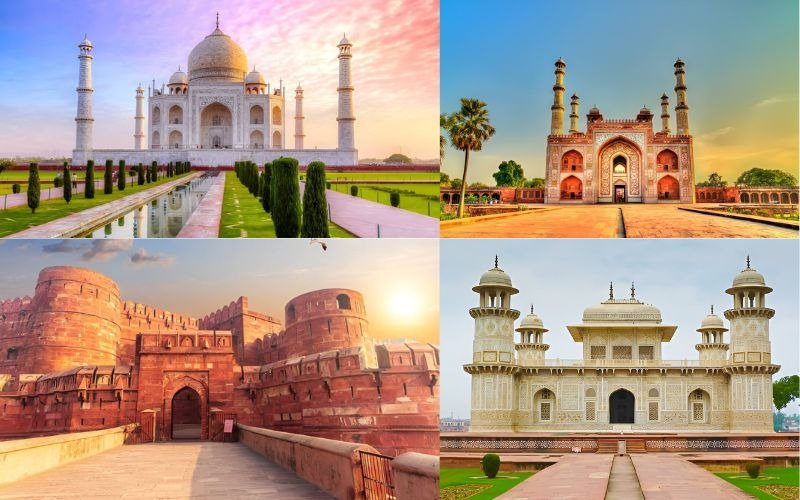
Agra served as a principal Mughal capital under Akbar, Jahangir and Shah Jahan, and its monuments show the empire’s artistic ambitions at their fullest. UNESCO lists the Taj Mahal, Agra Fort and Fatehpur Sikri as separate World Heritage properties.
Taj Mahal. Shah Jahan commissioned the Taj Mahal in memory of his wife Mumtaz Mahal, and it was built between 1631 and 1648. Its white marble, pietra dura (inlaid semi-precious stone), Quranic calligraphy and carefully balanced charbagh garden make it a masterpiece of Mughal design.
Agra Fort. Begun under Akbar in the 1560s and extended by Shah Jahan, this red sandstone fortress is effectively a walled imperial city. Its palaces, audience halls and mosques show the shift from sturdy sandstone toward refined white marble.
Itimad-ud-Daulah’s Tomb. Built in the 1620s by Nur Jahan for her father, this tomb is notable for its marble surfaces and detailed inlay. It is often seen as a stylistic bridge between earlier sandstone tombs and the Taj Mahal.
Agra’s story is bigger than any single monument. Visiting several sites helps show how Mughal architecture evolved across three generations of rulers.
Fatehpur Sikri — Where Mughal Architecture Meets Regional Traditions
Akbar founded Fatehpur Sikri in the second half of the 16th century and made it his capital for roughly a decade before the court moved away. It is a one of the best-preserved Mughal planned cities.
The red sandstone complex blends Persian-influenced planning with carving traditions from Gujarat and Rajasthan, visible in its brackets, jali screens and carved columns. Key sights include:
- Buland Darwaza: a towering gateway, completed in 1576, that rises above the Jama Masjid courtyard.
- Jama Masjid: a large congregational mosque, with the white marble tomb of Sheikh Salim Chishti in its courtyard.
- Palace structures: including the Panch Mahal and Diwan-i-Khas, where varied regional styles meet.
Fatehpur Sikri is around 40 km from Agra and sits on the usual road to Jaipur, so it works well as a heritage stop. Allow at least two hours on site, plus travel time.
Jaipur — Discovering Rajput Forts, Palaces, and Royal Traditions
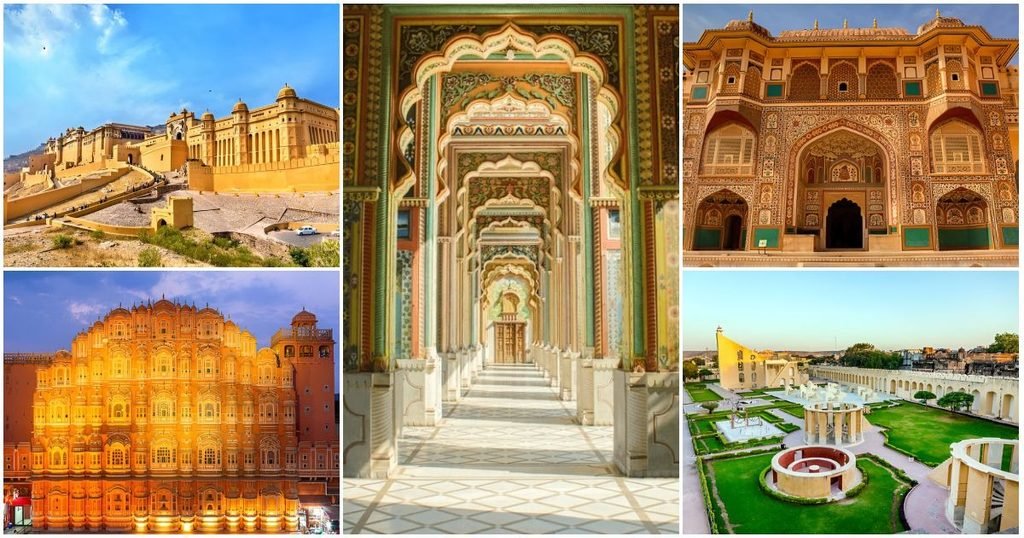
Jaipur, Rajasthan’s “Pink City,” was founded in 1727 by Maharaja Sawai Jai Singh II as a planned city with a grid of streets and bazaars. The historic city was inscribed by UNESCO in 2019 as an example of late medieval town planning and exchange of ideas.
Amber Fort. Amber was the Kachhwaha capital before Jaipur. Part of UNESCO’s Hill Forts of Rajasthan (2013), it combines defensive gateways with courtyards, gardens and the mirror-decorated Sheesh Mahal. Its 17th-century additions under Mirza Raja Jai Singh I show clear Mughal influence.
City Palace. Still partly a royal residence, this complex blends Rajput and Mughal elements in its courtyards, pavilions and museum galleries.
Hawa Mahal. Built in 1799, its façade of small windows (jharokhas) allowed royal women to watch street life without being seen.
Jaigarh and Nahargarh. These hill forts, tied to Jai Singh II and his successors, show how Rajput rulers used the Aravalli ridges for defence and for views over the city.
Look for chhatris (domed pavilions), painted gateways, fresco work and courtyard palaces. Jaipur’s craftsmanship came from royal patronage that drew artisans to the court.
Jaipur’s palaces, forts and old streets reward a slower visit, since much of the detail is in the carving, painting and layout rather than in a single famous façade.
Visitors who want additional time to appreciate Jaipur’s royal heritage alongside Delhi and Agra can explore our Golden Triangle Tour 5 Days itinerary.
Mughal vs Rajput Architecture — Key Differences to Look For
| Feature | Mughal (Delhi and Agra) | Rajput (Jaipur) |
| Materials | Red sandstone and white marble (Humayun’s Tomb, Taj Mahal) | Local sandstone and marble with lime plaster (Amber Fort, City Palace) |
| Planning | Symmetrical, axial layouts and charbagh gardens | Layouts adapted to hill terrain; palaces arranged around courtyards |
| Domes and arches | Bulbous, often double domes; pointed and cusped arches | Chhatris, curved roofs and multi-foiled arches (Hawa Mahal, Amber) |
| Courtyards and gardens | Formal geometric gardens around tombs | Courtyard palaces; terraced and water gardens at Amber |
| Defensive structures | Imperial forts on plains and rivers (Red Fort, Agra Fort) | Hilltop forts with ramparts and bastions (Amber, Jaigarh, Nahargarh) |
| Decoration | Pietra dura, calligraphy, jali screens | Jharokhas, mirror work, frescoes, painted gateways |
| Influences | Persian, Central Asian and Islamic religious traditions | Regional clan court culture, Hindu and Jain traditions, plus Mughal ideas |
These are broad tendencies, not absolute rules. Traditions overlapped, and each building reflects its patron, period and region. Fatehpur Sikri and Amber Palace show how readily the styles borrowed from one another.
Art, Craftsmanship, and Cultural Influences Along the Route
In Agra, pietra dura inlay is documented at the Taj Mahal and Itimad-ud-Daulah’s Tomb, and the city’s modern marble workshops continue the technique. Some families trace their ancestry to Mughal-era artisans, but those claims are hard to verify, so treat them as local tradition.
In Jaipur, courtly patronage supported stone carving, fresco and miniature painting, a field where Mughal and Rajput schools clearly influenced each other. Today, artisans continue traditional crafts such as block printing, blue pottery, gem-cutting, and jewellery-making. However, the origins of these crafts vary, and historians have documented some traditions more thoroughly than others.
When shopping, ask where and how an item was made, and visit a workshop if possible. It helps separate historical craft traditions from mass-produced souvenirs.
How to Explore Mughal and Rajput Heritage on a Golden Triangle Trip
- Divide your time: allow roughly one to one and a half days each for Delhi and Jaipur, and a full day for Agra.
- Hire a knowledgeable guide: a good guide can explain symbolism, dates and the connections between sites that signs often omit.
- Start early: major monuments are cooler and less crowded in the morning, and the light is better for photography.
- Plan for Fatehpur Sikri: break the Agra–Jaipur drive here rather than treating it as a quick stop.
- Dress for comfort and respect: wear comfortable shoes, use sun protection, carry water, and cover shoulders and knees at religious sites.
- Check official information: confirm opening days, entry rules and ticket details on the Archaeological Survey of India website or the monument’s official page before you go. The Taj Mahal traditionally closes every Friday, so check the opening schedule before planning your visit.
For travelers working with limited time, our Golden Triangle Tour 3 Days guide provides a starting point for planning a shorter Delhi–Agra–Jaipur journey, although a longer stay allows more time for historical exploration.
Final Thoughts on Mughal and Rajput Heritage Along the Golden Triangle
Delhi’s Mughal monuments, Agra’s imperial architecture and Jaipur’s Rajput forts and palaces together make a varied historical journey. Each city shows a different side of northern India’s past, and their overlaps are as interesting as their differences.
Look beyond the famous photographs. Notice the inlay on a marble wall, the way a gateway guides your approach, or a jharokha placed to frame a view. Understanding who built these places and why makes the experience richer.
If you are ready to turn this route into a trip, the itinerary options above are a good place to compare durations and pacing.
Frequently Asked Questions
1. What is the difference between Mughal and Rajput architecture?
Mughal architecture is known for symmetrical planning, domes, charbagh gardens, marble inlay and calligraphy, drawing on Persian and Central Asian traditions. Rajput architecture favours hilltop forts, courtyard palaces, jharokhas, chhatris and painted decoration. The two influenced each other, so many buildings combine features.
2. Which Mughal monuments should you visit in Delhi and Agra?
In Delhi, prioritise the Red Fort, Humayun’s Tomb and Jama Masjid. In Agra, visit the Taj Mahal, Agra Fort and Itimad-ud-Daulah’s Tomb. Fatehpur Sikri adds a different, earlier Mughal perspective.
3. Which Rajput forts and palaces are worth visiting in Jaipur?
Amber Fort and the City Palace are the main heritage highlights, with Hawa Mahal as an iconic façade. If time allows, Jaigarh and Nahargarh offer hilltop views and a sense of Rajput defensive design.
4. Is Fatehpur Sikri worth visiting on a Golden Triangle tour?
Yes, especially for history enthusiasts. It was Akbar’s capital for about a decade, is UNESCO-listed, and lies conveniently between Agra and Jaipur. Allow enough time rather than rushing through.
5. How many days are enough to explore Mughal and Rajput heritage?
Three to four days covers the main highlights at a brisk pace. Five days is more comfortable, and seven days suits travelers who want to explore in depth with a relaxed schedule.
6. What is the best time of year for a heritage trip to Delhi, Agra, and Jaipur?
October to March is usually the most comfortable period, with cooler days. December and January can bring morning fog and chilly starts. April to June is very hot, and July to September brings monsoon humidity and rain.
How Many Days Do You Need for a Heritage-Focused Golden Triangle Tour?
- Three to four days: suits travelers prioritising the major highlights, at a faster pace.
- Five days: allows more flexibility for monuments, a Fatehpur Sikri stop and some local culture.
- Seven days: gives time for deeper sightseeing, interpretation and a more relaxed schedule.
The right length depends on your interests, the monuments you most want to see, travel times and your arrival and departure arrangements.
If you prefer a slower journey with more time to explore the region’s historical landmarks, compare the itinerary offered by our Golden Triangle Tour 7 Days.