


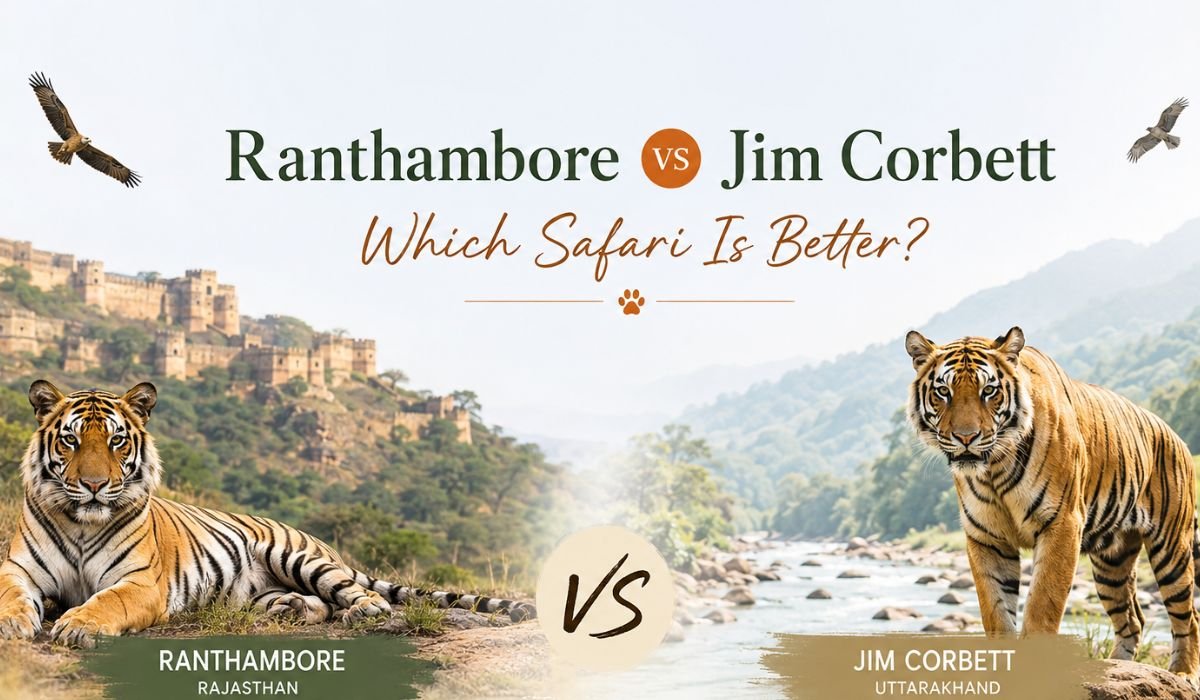
If you’re trying to decide between a Ranthambore vs Jim Corbett safari, you’re not alone — this is probably the most common question among first-time tiger safari travelers in India. Both parks sit at the top of nearly every wildlife lover’s list, but they offer genuinely different experiences.
Ranthambore, in Rajasthan, is known for open, dry forests where tigers move confidently in daylight, often near old fort ruins and lakes. Jim Corbett, tucked into the Himalayan foothills of Uttarakhand, is India’s oldest national park, with denser forests, rivers, and a much larger tiger population spread across a bigger landscape.
Neither park is objectively “better” for everyone. The right choice depends on how many days you have, how far you’re traveling from, your budget, and whether tiger sightings or overall wildlife diversity matter more to you. This guide breaks down accessibility, safari zones, tiger sighting odds, costs, photography conditions, and the best type of traveler for each park, so you can make the call with confidence.
Quick Comparison: Ranthambore vs Jim Corbett Safari
Here’s a side-by-side snapshot before we get into the details.
| Feature | Ranthambore National Park | Jim Corbett National Park |
| Location | Sawai Madhopur | Nainital & Pauri Garhwal districts |
| State | Rajasthan | Uttarakhand |
| Core Area | Around 400 sq km (1,334 sq km reserve) | Around 520 sq km (1,300+ sq km reserve) |
| Best Time to Visit | October to June (peak: April–May) | November to June (peak: March–May) |
| Number of Safari Zones | 10 zones (5 core, 5 buffer) | 6–8 zones depending on season |
| Famous Wildlife | Tigers, leopards, sloth bears, crocodiles | Tigers, elephants, leopards, over 600 bird species |
| Tiger Sighting Probability | High, especially in core Zones 3–4 | High in Dhikala and Bijrani, slightly lower elsewhere |
| Safari Types | Jeep (Gypsy) and Canter | Jeep and Canter (Dhikala) |
| Nearest Airport | Jaipur (~180 km) | Pantnagar (~80 km) or Dehradun |
| Nearest Railway Station | Sawai Madhopur | Ramnagar |
| Ideal Trip Duration | 2–3 days | 3–4 days |
| Best For | First-time visitors, weekend trips from Delhi/Jaipur, high tiger-sighting odds | Wildlife diversity, longer nature immersion, birdwatchers |
About Ranthambore National Park
Ranthambore began as a hunting reserve for the Maharajas of Jaipur before becoming a Project Tiger reserve in 1973. Today it’s one of the most visited tiger reserves in India, largely because its tigers are unusually visible compared to those in denser forests.
The landscape is dry deciduous forest dotted with lakes, rocky hills, and the dramatic Ranthambore Fort, a 10th-century UNESCO World Heritage Site that sits right inside the park. It’s not unusual for tigers to walk past the fort’s crumbling walls or rest inside its old chambers — a scene you won’t find anywhere else in India.
Three lakes — Padam Talao, Raj Bagh Talao, and Malik Talao — draw wildlife through the dry months, which is why sightings tend to spike in summer as animals gather near water. While Zones 1 to 5 are traditionally the most productive, recent field reports suggest Zones 6 and 10 are also seeing strong tiger movement.
Because of its location between Jaipur and Agra, the park is also a popular addition to a Golden Triangle Tour with Ranthambore, allowing travelers to combine India’s iconic heritage landmarks with an unforgettable wildlife safari in a single itinerary.
The park has produced several tigers with near-celebrity status over the years — legendary matriarchs and their descendants whose territories are still tracked by guides today. If you want a deeper breakdown of which zone suits your travel dates, our Ranthambore Safari Zones guide covers each one in detail.
About Jim Corbett National Park
Jim Corbett holds the distinction of being India’s first national park, established in 1936, and it was also the birthplace of Project Tiger in 1973. It’s named after Jim Corbett, the British-Indian hunter-turned-conservationist who helped establish it.
Corbett’s terrain is far more varied than Ranthambore’s. The park spans roughly 1,300 sq km, with altitudes ranging from 400 m to 1,200 m, and the landscape mixes open grasslands with dense Sal and Peepal forest, lakes, hills, marshes, and the Ramganga river running through it.
The park’s tiger density is among the highest in India, with tigers known for their notably large, robust build thanks to the thriving ecosystem.The Dhikala zone is generally considered the most reliable for tiger sightings because of its vast grasslands and high prey density, while Bijrani and Jhirna also deliver consistent sightings, particularly in peak summer when animals gather around water.
Beyond tigers, Corbett is genuinely one of the best all-round wildlife destinations in India — large elephant herds, a thriving bird population, and river ecosystems all add to the experience.
Tiger Sighting Comparison
This is usually the deciding factor for most travelers, so let’s be direct about it.
Ranthambore has an edge in predictability. In peak season (April to June), success rates over four safaris run around 70–80%, dropping to roughly 50–60% in winter. The open, dry terrain means tigers are easier to spot even at a distance, and Ranthambore’s tigers are known for being relatively unbothered by jeeps, so sightings tend to be longer and more relaxed.
Jim Corbett has an edge in sheer numbers. Corbett is home to over 260 Bengal tigers as per the 2022 tiger census, making it one of the highest tiger-density reserves in the world The catch is that Corbett’s forests are thicker, so even with more tigers around, actually spotting one can take longer and often depends heavily on which zone you’re allotted.
Seasonal changes matter for both parks. Summer is the peak sighting season everywhere in India, since animals concentrate around shrinking water sources. Winter brings pleasant weather and lush scenery but slightly lower sighting odds because of thicker vegetation and cooler tiger movement patterns.
Verdict: If tiger sightings are your single priority and you only have a couple of days, Ranthambore’s open landscape gives you better odds per safari. If you have more time and want to combine tigers with a bigger wildlife canvas, Corbett rewards patience.
Wildlife Diversity
Tigers get the headlines, but the surrounding wildlife is where these two parks really diverge.
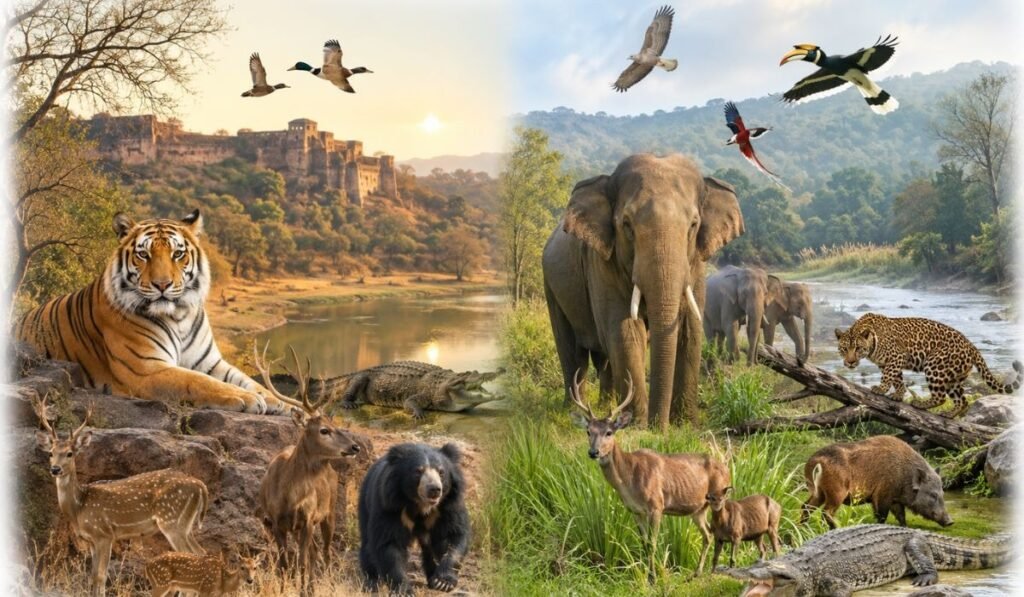
Ranthambore:
- Leopards (though less commonly seen than tigers, since they avoid tiger territory)
- Sloth bears, especially in Zone 4
- Marsh crocodiles around the lakes
- Chital, sambar, and nilgai in large numbers
- Over 270 recorded bird species, including migratory waterfowl at the lakes
Jim Corbett:
- Asian elephants, with herds of 100+ commonly seen in summer near Dhikala
- Leopards across several zones
- Wild boars, sambar, chital, barking deer, and the endangered Himalayan goral
- Over 600 recorded bird species, including the crested serpent eagle, paradise flycatcher, and great hornbill
- Gharials and mugger crocodiles along the Ramganga river
If variety beyond tigers matters to you, Corbett is the stronger all-rounder, largely because of its bigger elephant population and much larger bird checklist.
Safari Experience Comparison
The two parks run their safaris quite differently, and it affects how the day feels.
Ranthambore:
- Jeep Safari (Gypsy): Six-seater open vehicles, the most popular option, offering better mobility and photo angles.
- Canter Safari: 20-seater open buses, more affordable and easier to book on short notice.
- Zone system: The park uses a random zone allocation system for most bookings, so you can’t always choose your zone — one reason operators recommend booking multiple safaris to improve your odds of landing a core zone.
- Duration: Around 3.5 hours per safari, run in two shifts (morning and afternoon).
Since safari permits, zone allocation, and vehicle availability can significantly affect your wildlife experience, it’s worth reading a detailed Ranthambore Safari Booking Guide before making your reservation, especially if you’re traveling during the peak season.
Jim Corbett:
- Jeep Safari: Available in most zones like Bijrani, Jhirna, and Dhela.
- Dhikala Canter Safari: Dhikala, the park’s most productive zone, is accessible mainly by canter for day visitors, or by staying overnight at the Dhikala Forest Rest House if you can book a jeep permit.
- Forest rest houses: Corbett is one of the few Indian tiger reserves where you can stay inside the core zone overnight, which is a genuinely different experience from a same-day safari.
- Zone variety: With multiple zones open across different seasons (some, like Jhirna and Dhela, stay open even through monsoon), Corbett offers more year-round flexibility.
If you want step-by-step help with reservations, timings, and zone selection, our Ranthambore Safari Booking Guide walks through the entire process.
Best Time to Visit
Summer (March–June): The best season for tiger sightings in both parks, since water sources shrink and animals concentrate around them. Ranthambore gets very hot (up to 45°C), while Corbett’s foothill location keeps temperatures slightly more bearable.
Winter (November–February): Pleasant weather, lush green landscapes, and excellent birdwatching in both parks — but tiger sightings dip slightly due to thicker cover and cooler animal movement. This is a comfortable season for families and older travelers.
Monsoon (July–September): Ranthambore’s core zones close entirely during monsoon. Corbett keeps a few zones like Jhirna and Dhela open year-round, giving it a slight edge if you’re traveling in the rainy months.
For sighting-focused trips, April and May are consistently rated the strongest months at both parks, despite the heat.
Safari Cost Comparison
Costs vary by season, vehicle type, and whether you book directly or through an operator. Here’s a general 2026 range per person.
| Cost Component | Ranthambore (approx.) | Jim Corbett (approx.) |
| Jeep Safari Fee | ₹3,500–5,000 | ₹3,000–4,500 |
| Canter Safari Fee | ₹1,800–2,500 | ₹1,500–2,200 |
| Guide/Naturalist Charges | ₹300–500 | ₹300–600 |
| Vehicle Type | 6-seater Gypsy / 20-seater Canter | 6-seater Gypsy / Canter (Dhikala only) |
| Entry Permit | Included in safari fee | Included in safari fee |
| Accommodation (per night) | ₹2,500 (budget) to ₹25,000+ (luxury) | ₹2,000 (budget) to ₹20,000+ (luxury) |
Corbett tends to be marginally cheaper for the safari itself, but overnight stays inside Dhikala (forest rest houses) come at a premium and need to be booked well in advance.
Accessibility
Delhi:
- Ranthambore: ~400 km via Jaipur/Kota highway, roughly 6–7 hours by road, or an overnight train to Sawai Madhopur.
- Jim Corbett: ~250 km, roughly 5–6 hours by road, making it the easier weekend option from Delhi.
From Jaipur: Ranthambore is just 3–4 hours away, which is why it’s so often paired with a Rajasthan itinerary alongside Jaipur and Agra.
From Agra: Ranthambore is about 4.5 hours by road, making it a natural add-on to a Golden Triangle trip.
Nearest airports: Ranthambore’s closest airport is Jaipur (~180 km); Corbett is best reached via Pantnagar airport (~80 km) or Dehradun.
Nearest railway stations: Sawai Madhopur for Ranthambore (well connected to Delhi, Mumbai, and Jaipur); Ramnagar for Corbett (connected to Delhi via regular trains).
Road connectivity: Both parks have well-maintained highway access, though Corbett’s hill approach roads are narrower and slower after Ramnagar.
Overall, Corbett is the faster weekend getaway from Delhi, while Ranthambore fits more naturally into a Rajasthan circuit.
If you’re already planning to visit Delhi, Agra, and Jaipur, consider Planning a Golden Triangle Tour with Ranthambore to combine India’s iconic heritage sites with an unforgettable tiger safari in a single itinerary.
Photography Experience
Ranthambore is widely considered one of the best parks in India for tiger photography, largely because of its open terrain. Tigers here are visible for longer stretches, often in good light, with the added bonus of dramatic backdrops like the fort ruins and lake reflections. Golden-hour shots near Padam Talao are a favorite among wildlife photographers.
Jim Corbett offers a different kind of photography — layered forest light, misty mornings in the hills, river scenes with gharials basking on sandbanks, and exceptional bird photography thanks to its huge species count. Tiger shots can be harder to get cleanly due to denser foliage, but the overall scenic variety is richer.
If you’re chasing clean, close tiger portraits, Ranthambore usually wins. If you want a broader wildlife and landscape portfolio, Corbett offers more range.
Accommodation Options
Both parks cater to every budget, from forest lodges to five-star resorts.
- Luxury Resorts: Ranthambore has several well-known luxury properties near the park gates; Corbett’s riverside and forest-view resorts offer a similarly premium experience, often with more greenery.
- Mid-range Hotels: Both destinations have a strong cluster of comfortable, well-reviewed mid-range hotels close to the safari gates.
- Budget Hotels: Plentiful in both Sawai Madhopur and Ramnagar, generally starting under ₹2,500 a night.
- Forest Lodges: Corbett has a distinct advantage here — the Dhikala Forest Rest House lets you stay inside the core zone, something Ranthambore doesn’t offer in the same way.
Which Safari Is Better for Different Travelers?
| Traveler Type | Best Choice |
| Families | Ranthambore |
| Wildlife Photographers | Ranthambore |
| Tiger Lovers | Either (Ranthambore for odds, Corbett for volume) |
| Couples | Jim Corbett |
| Luxury Travelers | Either |
| Budget Travelers | Jim Corbett |
| Weekend Travelers (from Delhi) | Jim Corbett |
| Bird Watchers | Jim Corbett |
Families tend to prefer Ranthambore because safaris are shorter, tiger sightings are more predictable, and it pairs easily with a Rajasthan sightseeing trip. Couples often lean toward Corbett for its quieter, greener, more romantic hill setting and the option of an overnight forest stay. Bird watchers should head to Corbett without hesitation, given its far larger recorded species count.
Pros and Cons
Ranthambore
Pros:
- Higher, more predictable tiger sighting rates
- Open terrain ideal for photography
- Easy to combine with Jaipur and Agra
- Shorter safari duration, family-friendly
Cons:
- Zone allocation is largely random on official bookings
- Gets very crowded and hot in peak summer
- Core zones close entirely during monsoon
Jim Corbett
Pros:
- Largest tiger population among India’s reserves
- Much greater overall wildlife and bird diversity
- Some zones stay open year-round
- Option to stay overnight inside the core zone
Cons:
- Denser forest can make tiger sightings less consistent
- Dhikala’s best area is canter-only for day visitors
- Slightly longer trip needed to see the park properly
FAQs
1. Which safari has better tiger sightings — Ranthambore or Jim Corbett?
Ranthambore generally offers more predictable sightings due to its open terrain, especially in peak summer. Corbett has more tigers overall, but its denser forest can make spotting them harder.
2. Is Ranthambore better than Jim Corbett?
Neither is universally “better” — Ranthambore suits travelers prioritizing tiger sightings and shorter trips, while Corbett suits those wanting broader wildlife diversity and a longer nature immersion.
3. Which park is best for wildlife photography?
Ranthambore for close, clean tiger shots thanks to open terrain; Corbett for scenic landscapes, river wildlife, and bird photography.
4. Which safari is cheaper?
Jim Corbett’s safari fees are slightly lower on average, though both parks have similar accommodation cost ranges from budget to luxury.
5. Which park is easier to reach from Delhi?
Jim Corbett, at roughly 250 km and 5–6 hours by road, is closer than Ranthambore’s 400 km, 6–7 hour drive.
6. Is Jim Corbett good for first-time visitors?
Yes, though first-timers should plan for at least 3 days and try to secure a Dhikala or Bijrani zone permit for the best chance of tiger sightings.
7. Which safari is better for families?
Ranthambore, thanks to shorter safari durations, higher sighting predictability, and easy pairing with Rajasthan’s family-friendly sightseeing circuit.
8. How many days are enough for each park?
2–3 days at Ranthambore and 3–4 days at Jim Corbett are generally enough to cover the main zones and get a fair shot at tiger sightings.
9. Can I visit both parks in one trip?
Yes, though they’re roughly 500–600 km apart, so it typically works best as two separate trip legs rather than a single continuous journey.
10. When should I book a safari?
Both parks allow booking around 90–120 days in advance, and peak season slots (April–May) fill up quickly, so booking early is strongly recommended.
Final Verdict
There’s no single “winner” in the Ranthambore vs Jim Corbett safari debate — it genuinely comes down to what you’re optimizing for.
- For tiger sightings on a short trip: Ranthambore’s open landscape and predictable patterns give you better odds per safari.
- For overall wildlife diversity: Jim Corbett’s elephants, birdlife, and river ecosystems make it the richer, more varied destination.
- For photography: Ranthambore for clean tiger shots; Corbett for scenic and bird photography.
- For accessibility: Corbett is the easier weekend trip from Delhi; Ranthambore fits naturally into a Rajasthan itinerary.
- For budget: Corbett is marginally cheaper on safari fees, though both scale up quickly with luxury stays.
- For overall experience: If you can only pick one, Ranthambore tends to edge out for first-time visitors chasing a tiger sighting, while Corbett is the better pick for a longer, more immersive wildlife holiday.
If your schedule allows it, seeing both parks — even a few months apart — gives you a genuinely complete picture of India’s tiger conservation landscape, from Rajasthan’s dry forests to the Himalayan foothills. For planning your Ranthambore leg, it’s worth checking our guide on the best time to book a Ranthambore safari so you don’t miss peak-season slots.
Before finalizing your trip, reviewing a detailed Golden Triangle Tour Itinerary can help you decide how many days to spend in Delhi, Agra, Jaipur, and Ranthambore while making the most of your travel time.