



The Taj Mahal is more than India’s most recognizable monument. Behind its white marble façade lies an extraordinary combination of Mughal architecture, artistic craftsmanship, mathematical precision, and centuries of history. For anyone exploring a detailed Taj Mahal Secrets, understanding these lesser-known features can make a visit to the monument far more meaningful.
Built in Agra during the reign of Mughal emperor Shah Jahan, the Taj Mahal was commissioned in memory of his wife Mumtaz Mahal. Today, the monument is a UNESCO World Heritage Site and one of India’s most celebrated cultural landmarks.
Many visitors admire its beauty without noticing the ingenious architectural details hidden throughout the complex. From carefully designed optical illusions to intricate marble inlay work, here are ten fascinating secrets and lesser-known facts that reveal why the Taj Mahal remains one of the world’s greatest architectural achievements.
1. The Entrance Creates a Remarkable Optical Illusion
Your first view of the Taj Mahal through the monumental gateway is one of the most memorable moments of any visit.
As you approach the complex through the main entrance, the monument appears beautifully framed within the enormous archway. The relationship between the gateway, the long garden axis, and the mausoleum creates a striking visual effect.
As you move through the entrance and continue toward the Taj Mahal, your perception of its scale and distance changes. The carefully planned perspective of the Mughal garden contributes to the dramatic reveal.
This is one reason visitors should avoid rushing directly toward the monument. Spend a few moments at the gateway and observe how the view changes as you move forward.
The experience demonstrates how Mughal architects used not only physical structures but also perspective and visual composition to influence how visitors experience the complex.
2. The Minarets Were Designed with Structural Considerations
Four tall minarets stand at the corners of the Taj Mahal’s main marble platform.
Rather than being incorporated directly into the central mausoleum, they are positioned separately at the platform’s outer corners. The minarets are commonly described as having a slight outward inclination, a feature often interpreted as helping protect the central structure if a minaret were ever to fall.
Their placement also contributes significantly to the visual balance of the monument.
From the front, the four minarets frame the central dome and create the symmetrical composition for which the Taj Mahal is famous.
Their design shows that the architects responsible for the complex considered both appearance and structural planning.
3. The Mystery of the Black Taj Mahal
One of the most famous legends associated with the Taj Mahal is the story of a second mausoleum supposedly planned across the Yamuna River.
According to the popular tale, Shah Jahan intended to construct a “Black Taj Mahal” for himself using dark marble, creating a dramatic counterpart to the white Taj Mahal built for Mumtaz Mahal.
The story has fascinated historians and travelers for generations.
The theory is often connected with the ruins and dark-colored features found at Mehtab Bagh, the Mughal garden located directly across the Yamuna River.
However, there is no conclusive archaeological evidence proving that Shah Jahan actually planned to build an entire black marble Taj Mahal.
The story should therefore be understood as a fascinating historical legend rather than an established fact.
Nevertheless, visiting Mehtab Bagh offers an excellent opportunity to appreciate the relationship between the Taj Mahal and the Yamuna River.
4. The Taj Mahal Has Rooms Closed to Regular Visitors
Parts of the Taj Mahal complex are not accessible to the general public, including rooms located within the lower sections of the monument.
These closed spaces have naturally generated considerable curiosity and numerous stories over the years.
However, restricted access to historical structures is not unusual. Areas may remain closed for conservation, structural protection, security, or visitor management.
Claims that these rooms contain hidden treasures or extraordinary secret discoveries are generally based on speculation rather than established historical evidence.
The existence of inaccessible spaces does, however, remind visitors that the Taj Mahal is much more architecturally complex than the sections normally seen during a standard tour.
The monument includes multiple levels, chambers, passages, and structural spaces that contributed to its construction and long-term preservation.
5. Its Water System Was an Engineering Achievement
The famous reflecting pool and fountains of the Taj Mahal were not simply decorative additions.
Water was a fundamental part of the overall Mughal garden design.
The historic system used mechanisms traditionally described as Persian wheels to raise water, along with channels, tanks, and distribution systems that supplied different parts of the complex.
Water played an important role in maintaining the gardens and creating the reflective surfaces that contribute to some of the Taj Mahal’s most iconic views.
The long central pool reflects the mausoleum and strengthens the visual symmetry of the garden.
Considering that the complex was developed during the 17th century, the planning required to manage and distribute water across such a large site demonstrates the sophisticated engineering knowledge available to Mughal builders.
6. Thousands of Pieces Create the Marble Inlay Designs
Look closely at the walls of the Taj Mahal and you will discover that many of its colorful floral patterns are not simply painted onto the marble.
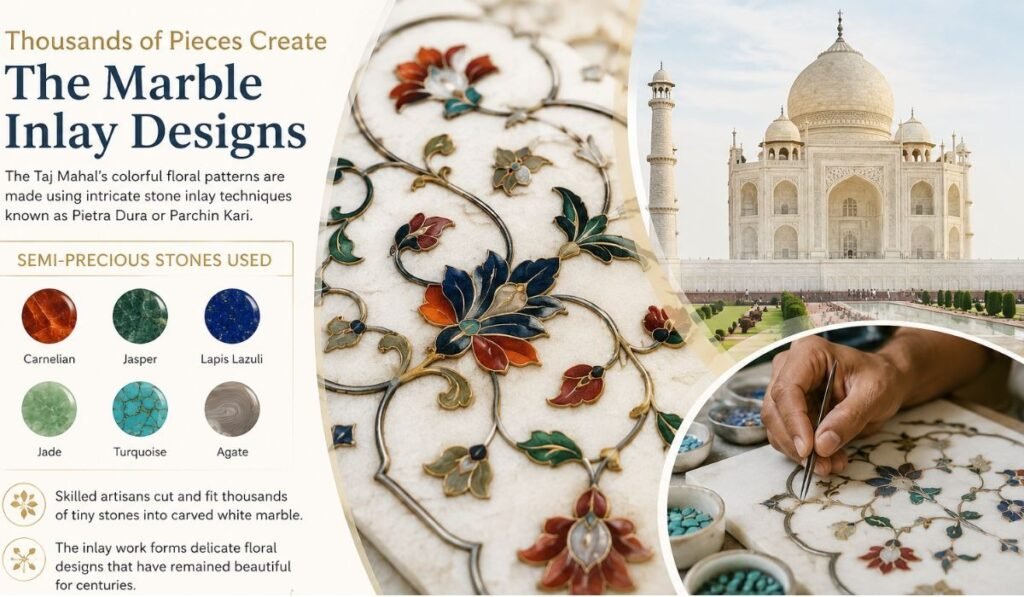
They are created using intricate stone inlay techniques commonly associated with pietra dura, known in the Mughal artistic tradition as parchin kari.
Skilled artisans carefully cut pieces of colored and semi-precious stones and fitted them into carved sections of white marble.
Materials traditionally associated with the decorative work include stones such as:
- Carnelian
- Jasper
- Lapis lazuli
- Jade
- Turquoise
- Agate
The craftsmanship is particularly impressive when viewed at close range.
Visitors interested in this artistic tradition can also find marble inlay workshops in Agra, where craftspeople continue to demonstrate techniques inspired by Mughal-era craftsmanship.
This decorative art is one of the most remarkable details to look for when following a Taj Mahal Secrets focused on architecture and design.
7. The Calligraphy Uses a Clever Visual Technique
The Taj Mahal’s calligraphy is another example of extraordinary attention to visual perception.
Quranic inscriptions appear around several important architectural features, particularly the monumental gateway and entrances to the mausoleum.
When viewed from ground level, the lettering appears remarkably consistent.
However, letters positioned higher on the structure were designed at a larger scale. This adjustment helps compensate for viewing distance and perspective, creating the impression that the script maintains more consistent proportions when seen from below.
The technique demonstrates the close relationship between art, mathematics, and architecture within the Taj Mahal complex.
The inscriptions are traditionally associated with the calligrapher Amanat Khan Shirazi, whose work contributed significantly to the monument’s visual identity.
8. Shah Jahan’s Cenotaph Breaks the Perfect Symmetry
Symmetry is one of the defining characteristics of the Taj Mahal.
The gardens, waterways, pathways, minarets, and architectural structures were carefully arranged around a central axis.
However, there is one famous exception inside the mausoleum.
The cenotaph of Mumtaz Mahal occupies the central position, while Shah Jahan’s cenotaph was later placed beside hers.
This arrangement disrupts the otherwise carefully maintained symmetry of the interior.
The visible structures that visitors see inside are ceremonial cenotaphs. The actual graves are located in a lower chamber, following traditional Islamic burial practices.
This asymmetry is especially interesting because it was created after the original design of the mausoleum, when Shah Jahan was buried alongside Mumtaz Mahal following his death.
9. The Yamuna River Was Part of the Original Landscape Design
The Taj Mahal was not designed as an isolated building.
Its location beside the Yamuna River formed an important part of the overall composition.
The riverfront setting influenced how the monument was approached, viewed, and connected with the surrounding Mughal landscape.
Across the river lies Mehtab Bagh, which provides one of the most famous distant views of the Taj Mahal.
Historical discussions about the monument’s foundations have also drawn attention to the importance of groundwater and the riverside environment. However, simplified claims that the Taj Mahal depends entirely on the river to prevent wooden foundations from collapsing should be treated carefully because the monument’s foundation system is complex.
What is clear is that the Yamuna remains an essential part of the Taj Mahal’s historical landscape.
Protecting the surrounding environment is therefore important not only for Agra but also for preserving the broader heritage setting of the monument.
10. The Taj Mahal Changes Character Throughout the Day
One of the most fascinating qualities of the Taj Mahal is how different it can appear depending on the time of day and atmospheric conditions.
At sunrise, the marble may take on soft, warm tones.
Under stronger daylight, the monument often appears bright white against the sky.
Toward sunset, warmer light can change the appearance of the marble again.
This visual transformation happens because white marble interacts with changing natural light, weather conditions, haze, and the colors of the surrounding sky.
For photographers and first-time visitors, this makes timing an important part of planning a visit.
Early morning is particularly popular because the light can be beautiful and temperatures may be more comfortable, although visitor numbers and visibility vary by season.
Bonus: The Taj Mahal Is Much More Than a Single Building
Many first-time visitors imagine the Taj Mahal as simply the famous white marble mausoleum.
In reality, it is an extensive architectural complex.
The site includes:
- The main mausoleum
- A monumental entrance gateway
- Formal Mughal gardens
- Reflecting pools and waterways
- A mosque
- A matching jawab building
- Additional gateways and structures
Understanding the complete complex helps visitors appreciate the enormous scale of the project.
The Taj Mahal should therefore be experienced as an integrated landscape rather than only as a single monument.
How Long Did It Take to Build the Taj Mahal?
Construction of the main mausoleum began in the 17th century following the death of Mumtaz Mahal in 1631.
The principal mausoleum was completed earlier than the entire complex, while work on additional buildings, gardens, and decorative elements continued afterward. The overall project is generally understood to have taken roughly two decades.
Thousands of artisans and workers contributed to different aspects of its construction.
The project brought together expertise in architecture, stone carving, calligraphy, marble inlay, garden planning, and engineering.
This collaboration is one reason the Taj Mahal represents such an important achievement of Mughal architecture.
Practical Tips for Visiting the Taj Mahal
Knowing the monument’s secrets is only one part of planning a memorable visit. A few practical considerations can make your experience more comfortable.
Choose Your Visiting Time Carefully
Early morning is popular for softer light and potentially more comfortable temperatures. However, winter mornings in Agra can sometimes experience fog.
Remember the Weekly Closure
The Taj Mahal is generally closed to regular tourists on Fridays, so plan your itinerary accordingly and verify current rules before visiting.
Carry Only Essential Items
Security restrictions apply at the monument, and certain items cannot be taken inside. Traveling with a small bag and checking current entry regulations beforehand can save time.
Wear Comfortable Shoes
The complex is extensive, and visitors should expect a considerable amount of walking.
Allow Enough Time
Most visitors should plan at least two to three hours to explore the main areas without rushing.
Travelers coming from Delhi who want flexibility and private transportation can consider a Same Day Taj Mahal Tour by Car, allowing them to visit Agra and return within the same day.
Those traveling from Rajasthan can instead plan a Same Day Agra Tour from Jaipur, which makes it possible to experience the Taj Mahal and other important Agra attractions as part of a carefully planned day trip.
What Else Should You Visit in Agra?
While the Taj Mahal is undoubtedly Agra’s most famous attraction, the city has much more to offer.

Agra Fort
This impressive Mughal fort provides valuable historical context about the emperors connected with the Taj Mahal. Several sections also offer distant views toward the monument.
Mehtab Bagh
Located across the Yamuna River, this historic garden is popular for views of the Taj Mahal, particularly during the later part of the day.
Itmad-ud-Daulah
Sometimes called the “Baby Taj,” this elegant Mughal tomb is known for its delicate marble decoration and intricate inlay work.
Local Marble Workshops
Visiting a reputable marble inlay workshop can help travelers understand the extraordinary craftsmanship behind the decorative techniques seen at the Taj Mahal.
Including some of these attractions can provide a more complete understanding of Agra’s Mughal heritage.
Why the Taj Mahal Remains One of the World’s Greatest Monuments
The Taj Mahal’s global reputation is not based on a single feature.
Its beauty comes from the combination of architecture, landscape planning, craftsmanship, symmetry, engineering, and historical meaning.
The closer you look, the more details become visible.
The marble contains delicate stone inlays. The calligraphy incorporates perspective. The minarets frame the mausoleum. The gardens guide the visitor’s view. The Yamuna completes the historical landscape.
Even the monument’s famous symmetry contains a human exception in the placement of Shah Jahan beside Mumtaz Mahal.
These layers of detail are what make the Taj Mahal fascinating even for travelers who have visited more than once.
Final Thoughts
The Taj Mahal is far more than a monument to admire from a distance. Every part of the complex reveals another layer of Mughal creativity, from its carefully planned perspectives and intricate stonework to its sophisticated gardens and architectural symmetry.
Some stories associated with the Taj Mahal, such as the legendary Black Taj Mahal, remain fascinating mysteries rather than confirmed historical facts. Others, including its marble inlay work, calligraphic perspective, and remarkable landscape planning, can still be observed by visitors today.
The next time you stand before the Taj Mahal, spend time looking beyond the famous postcard view. Observe the gateway, examine the marble decoration, notice the calligraphy, walk through the gardens, and consider how each element contributes to the complete experience.
For travelers planning a broader journey through North India, India Golden Triangle Tours provide an opportunity to combine the Taj Mahal in Agra with the historic landmarks of Delhi and the royal heritage of Jaipur. Together, these destinations offer a deeper introduction to India’s architecture, history, culture, and artistic traditions.