
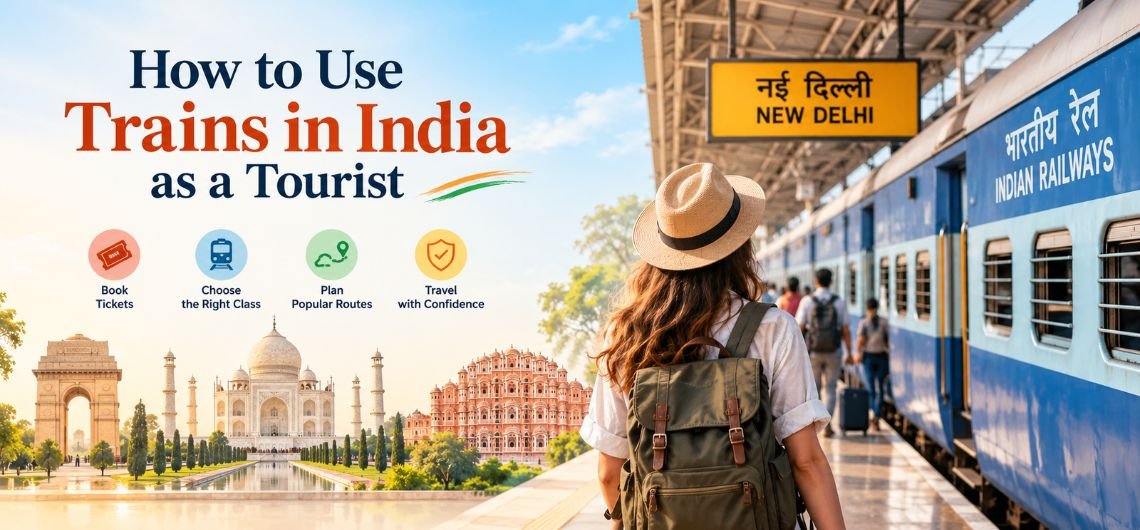
Picture this: you have just landed in India, your hotel is booked, and you want to take a train to the next city. Which website do you use? What does the ticket mean? Which platform do you go to, and where exactly do you stand to board your coach?
If you are wondering how to use trains in India as a tourist, you are not alone. Busy stations, unfamiliar terms and a booking system built mainly for residents can feel confusing at first. The good news is that a little preparation makes rail travel far easier.
Trains offer a close look at India’s landscapes, cities and everyday life. This guide explains how to book tickets, choose a class, find your platform, behave onboard and stay safe. It also uses the Delhi–Agra–Jaipur Golden Triangle as a practical example of planning a rail journey.
Why Should Tourists Consider Travelling by Train in India?
Indian Railways is one of the world’s largest rail networks, and it links major cities with many smaller towns. For visitors, the appeal goes beyond transport.
- Wide coverage: Many tourist destinations are reachable by rail, from big cities to smaller towns.
- Choice of classes: Options range from simple seating to private air-conditioned compartments, so you can match your budget and comfort needs.
- A window into daily life: You share the journey with families, students and workers, which is hard to experience from a car.
- Useful for selected routes: Some city-to-city journeys, especially overnight ones, can save a hotel night and a long drive.
Trains are not automatically the best choice for every route, though. Always compare total journey time, including the trip to the departure station, check-in time, and the transfer from the arrival station to your hotel. On some routes a car or a flight is simply more practical.
How to Use Trains in India as a Tourist: Understanding the Indian Railway System
Before booking, it helps to know a few basic terms.
- Train number and name: Each train has a unique number (usually five digits) and a name. Use the number when searching, because names can be similar.
- Departure and arrival stations: These are listed on your ticket with short station codes.
- Scheduled times: Departure and arrival times are shown in the 24-hour format.
- Coach, seat or berth number: Your ticket shows the coach (for example, B2) and your seat or berth number within it.
- PNR number: A ten-digit Passenger Name Record number that identifies your booking. You can use it to check your reservation status.
- Reservation status: Tickets can be confirmed, on a waiting list, or subject to other status codes. Only a confirmed status guarantees a seat or berth.
- Reserved vs unreserved: Reserved travel gives you an assigned seat or berth. Unreserved travel does not, and can be very crowded, so most tourists choose reserved accommodation.
One important point: large cities often have several railway stations. Delhi, for example, has more than one major station. Always check the exact station name on your ticket rather than relying on the city name alone.
How to Book Train Tickets in India as a Tourist
Booking procedures and eligibility can change, and they may differ for international visitors. Treat the steps below as a general outline, and confirm current rules on the official IRCTC website and Indian Railways pages.
- Decide your route and travel date. Know your starting station, destination and flexibility.
- Search for trains on the official IRCTC website or app, where eligible. Indian Railways also sells tickets at reservation counters.
- Compare your options. Look at departure times, journey duration, available classes and station locations.
- Check current requirements. Review registration, identity verification, payment and foreign-traveller rules. Foreign visitors may be able to use a Foreign Tourist Quota on selected trains, which has historically allowed bookings further ahead than the regular window, but availability and conditions vary by train and can change.
- Enter passenger details accurately. Names and passport or ID details should match your documents.
- Review the booking and fare carefully before paying.
- Save your confirmation and PNR. Keep a digital copy and an offline copy.
- Recheck status before departure. Confirm the train, platform and timing again on the travel day.
For regular bookings, Indian Railways currently opens reservations a limited number of days before travel (the advance reservation period has been 60 days, excluding the day of journey, since November 2024). Rules like this can be revised, so verify the latest information. Popular trains can sell out quickly, so book early.
Do not assume that every foreign-issued card, phone number or payment method will work smoothly with the booking system. If you find the process difficult, authorised booking assistance can help. Always verify an agent’s legitimacy and ask for a clear breakdown of all charges before you pay.
Which Train Class Should Tourists Choose in India?
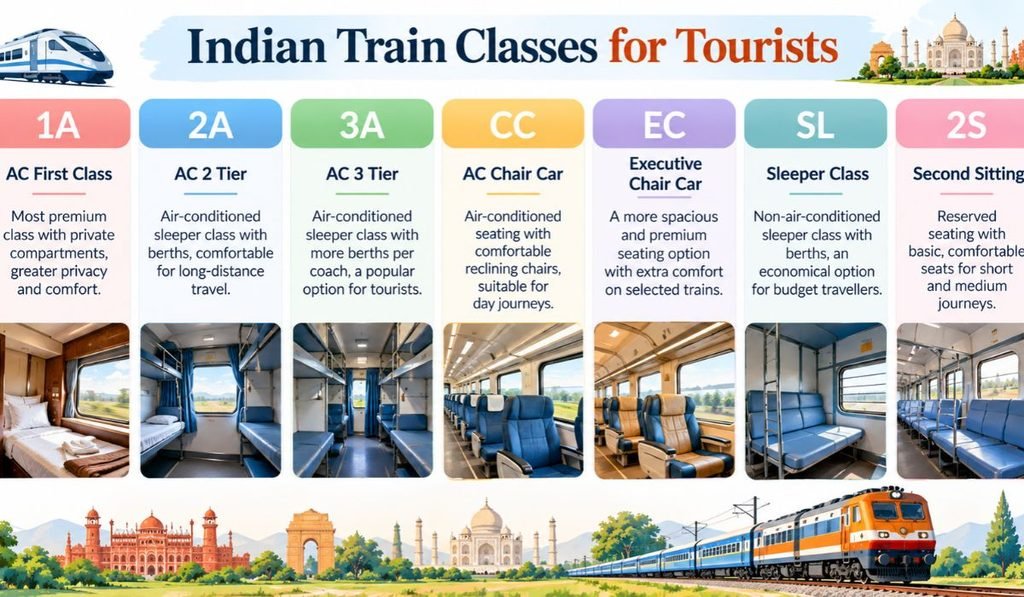
The classes available depend on the train, so never assume every class exists on every service. Here is a simple overview.
| Class | What it is | Best for |
|---|---|---|
| AC First Class (1A) | Premium air-conditioned travel with greater privacy, on trains that offer it | Travellers wanting privacy and comfort on longer journeys |
| AC 2 Tier (2A) | Air-conditioned sleeper with berths arranged in compartments | Overnight travel with a balance of comfort and cost |
| AC 3 Tier (3A) | Air-conditioned sleeper with more berths per section | Budget-conscious travellers who still want air conditioning |
| AC Chair Car (CC) | Reserved reclining seats, usually on daytime services | Day journeys between nearby cities |
| Executive Chair Car (EC) | More spacious premium seating on selected trains | Day travel with extra legroom |
| Sleeper Class (SL) | Non-air-conditioned sleeper accommodation | Experienced, budget-focused travellers; can be hot and busy |
| Second Sitting (2S) | Reserved seating on eligible services | Short, simple journeys |
How to choose: Think about journey length, budget, climate and privacy. For long overnight trips, a berth in an air-conditioned class is usually more restful. For a short daytime trip, a chair car can work well. In hot months, air conditioning makes a noticeable difference.
What Are the Best Train Routes for Tourists Visiting India?
There is no single definitive ranking. These popular examples show how rail can fit into an itinerary.
- Delhi to Agra: The most common route for visiting the Taj Mahal. Several services link the two cities, so compare timings and arrival stations.
- Delhi to Jaipur: A popular way to reach Rajasthan’s capital, with a choice of daytime and other services.
- Agra to Jaipur: This can form part of a Golden Triangle itinerary, but direct options and timings vary, so check current services carefully.
- Longer journeys: Routes to destinations further across India are where overnight trains can be especially useful.
You may see names such as Gatimaan Express, Vande Bharat Express and Shatabdi Express. These are premium, generally daytime services on specific routes. Mention of a train name is not a promise that it serves your route or runs on your date, because train services, journey durations, departure stations and operating days can change. Verify the exact train and the current timetable before booking.
How to Navigate an Indian Railway Station
Stations can be large and busy. A few habits make them manageable.
- Arrive early enough to find your platform without rushing. Allow extra time for large stations, crowds and any transfers.
- Check the electronic departure boards and listen for station announcements.
- Read your train number carefully and note your coach position.
- Ask official railway staff if you are unsure, such as uniformed staff at help desks or enquiry counters.
- Use station facilities such as waiting rooms where available, and keep your luggage organised and close.
Platform numbers and coach positions can change, so always check the latest information at the station rather than relying only on your earlier booking details.
What to Expect During a Train Journey in India
Experiences vary by train and class, so expect differences rather than a single standard.
- Seats and berths: Reserved accommodation gives you an assigned place. On sleeper trains, berths are usually converted between seating and sleeping.
- Bedding and meals: Some services and classes include bedding or meals, while others do not. Check your ticket and class details.
- Catering: Pantry cars and catering depend on the service. On some trains, vendors walk through the coaches, so buy only from sources you trust.
- Toilets and facilities: Basic toilets are available, and their condition can vary.
- Charging and connectivity: Charging points and mobile signal may vary by coach and route.
- Essentials to carry: Drinking water, essential medication, tissues, a light layer for air-conditioned coaches, and personal items.
Do not count on a specific amenity being available on every train.
Train Travel Safety Tips for Tourists in India
Millions of people use Indian trains every day. Sensible precautions for busy public transport are usually enough.
- Keep your passport, money, phone and valuables secure and close to you.
- Do not leave luggage unattended. A cable or lock for bags can add peace of mind.
- Choose reserved accommodation that suits the journey.
- Verify the identity of any staff member or booking agent offering help.
- Do not share booking details or sensitive information unnecessarily.
- Be careful stepping on and off trains and when crossing platforms.
- Use official railway channels to report problems.
- Keep offline copies of tickets, hotel details and emergency contacts.
Indian Train Etiquette Every Tourist Should Know
Good manners help everyone travel comfortably.
- Keep your voice and phone volume low, especially on night trains.
- Respect other passengers’ reserved seats and berths.
- Ask before photographing people.
- Keep shared areas tidy and take your rubbish with you.
- Follow coach-specific rules, such as lights-out times in sleeper coaches.
Fellow passengers are often friendly and helpful. Even so, confirm important travel information through official sources.
Train Travel vs Private Car for Exploring the Golden Triangle
Trains can be efficient for selected city-to-city journeys. A private car offers flexibility for hotel pickups, sightseeing transfers, luggage handling and stops along the way. The Delhi–Agra–Jaipur circuit shows why the best choice depends on your itinerary, not on one universal rule.
| Factor | Train | Private car |
|---|---|---|
| City-to-city leg | Can be efficient on suitable services | Door-to-door, with no station transfers |
| Flexibility | Fixed timetable | You can adjust stops and timing |
| Luggage | You carry and manage it | Handled by the driver |
| Sightseeing between cities | Limited | Easy to add stops |
| Booking effort | Needs reservations and checks | Arranged as a single plan |
| Experience | Local atmosphere | Comfort and privacy |
Travellers can compare routes and transportation options in this Golden Triangle Tour itinerary before deciding whether to travel by train, car, or a combination of both.
How to Plan a Delhi–Agra Train Journey to Visit the Taj Mahal
Delhi to Agra by train is a popular choice, but good planning keeps the day relaxed.
- Check suitable services and arrival times. Make sure the train arrives early enough to leave time for sightseeing.
- Plan transport in Agra. Work out how you will get between the railway station, your accommodation and the attractions.
- Allow time for security and entry. The Taj Mahal has security checks and entry procedures, which can take time.
- Consider staying overnight. An overnight stay can make an early visit easier and the itinerary less rushed.
- Check the opening days and entry details. The Taj Mahal is generally closed to general visitors on Fridays, so confirm the current rules on official sources before you finalise your plans.
Do not assume every train schedule supports a convenient same-day sightseeing trip.
For travellers who prefer organised road transport and sightseeing instead of managing every transfer independently, a Same Day Taj Mahal Tour by Car is a car-based alternative worth considering.
Common Train Travel Mistakes Tourists Should Avoid
| Mistake | Simple solution |
|---|---|
| Booking the wrong station | Check the station name and code on the ticket, not just the city |
| Assuming a waitlisted ticket guarantees a berth | Treat only a confirmed status as guaranteed, and have a backup plan |
| Arriving at the last minute | Arrive early to find your platform and coach |
| Not checking schedule and total journey time | Compare the full door-to-door time, including transfers |
| Assuming every train has air conditioning, catering or the same luggage arrangements | Check the class and train details in advance |
| Leaving no buffer before a flight or tour | Allow generous extra time for delays |
| Ignoring cancellation, refund and ticket-change conditions | Read the conditions before you pay |
How to Combine Train Travel with a Golden Triangle Holiday
Many visitors use trains for selected intercity legs and arrange local transport separately for sightseeing. For example, you might take a train between two cities and use a driver for local touring.
A tightly scheduled trip leaves little room for delays, while a more relaxed itinerary gives you breathing space. Travellers with limited time, families, or visitors carrying substantial luggage may prefer a coordinated transport plan, because it reduces the number of transfers to manage.
To see how sightseeing and transfers fit together, you can review a Golden Triangle Tour 4 Days Delhi–Agra–Jaipur itinerary. It is a road-based sightseeing itinerary, not a train-only tour, but it shows how time is typically divided between the three cities.
Essential Checklist Before Boarding a Train in India
Save or screenshot this list before you travel.
- Ticket confirmation and PNR details
- Passport or accepted identification
- Correct station name and train number
- Coach and seat or berth details
- Departure time and platform confirmation
- Hotel address and onward transport arrangements
- Phone charger or power bank
- Drinking water and necessary personal items
- Secure luggage and valuables
- A backup plan in case of a delay or cancellation
Follow current railway rules on identification, luggage and prohibited items.
Frequently Asked Questions About Train Travel in India
Is it easy for tourists to travel by train in India?
It can be, with preparation. Booking early, checking the exact station, choosing a suitable class and arriving with time to spare make the experience much smoother. First-time visitors often find the booking system and busy stations the hardest parts, but both become manageable with a little planning.
How can foreigners book train tickets in India?
Foreign visitors can usually book through the official IRCTC website or app, where eligible, or at railway reservation counters. A Foreign Tourist Quota may be available on selected trains. Registration, identity and payment requirements can change, so check official sources and consider authorised assistance if you need help.
Do tourists need an Indian phone number to book train tickets?
Requirements depend on the booking channel and current rules. Foreign visitors have historically been able to register with an international number, but verification steps can change. Check the current IRCTC instructions before you book, and use authorised help if you cannot complete registration yourself.
Which train class is best for international tourists?
There is no single best class. Air-conditioned classes such as 2A, 3A or Chair Car are popular because they are more comfortable, especially in hot weather. For privacy on long journeys, 1A may suit you, where it is offered. Availability depends on the train, so check each service.
How early should I arrive at an Indian railway station?
Arrive early enough to find your platform and coach without rushing. Large and busy stations, security checks and crowds can take extra time, so allow a generous buffer. Check the departure boards and announcements when you arrive, because platform numbers can change.
Is it safe to travel by train in India with luggage?
Many travellers do so without problems. Keep valuables close, never leave bags unattended, and consider a lock or cable for larger bags. Choose reserved accommodation and keep luggage organised. These precautions are standard for busy public transport and not specific to India.
Can I travel from Delhi to Agra by train to visit the Taj Mahal?
Yes, several services connect Delhi and Agra. Check current timetables, arrival stations and operating days before booking, and plan transport from the station to your hotel and the monument. Remember the Taj Mahal is generally closed to general visitors on Fridays, so confirm current information.
Is it better to travel between Delhi, Agra and Jaipur by train or private car?
It depends on your priorities. Trains can work well for selected city-to-city legs, while a private car offers flexibility, luggage handling and sightseeing stops. Many travellers use a combination. Compare total journey time, convenience and comfort rather than relying on one rule.
What happens if an Indian train is delayed or cancelled?
Delays can happen, so keep a buffer in your plans. If a train is cancelled or heavily delayed, refund and rebooking options depend on current Indian Railways rules and your ticket type. Check official announcements, use official railway channels for help, and avoid tight connections with flights or tours.
Should tourists book Indian train tickets in advance?
Yes, in most cases. Popular trains and classes can sell out, and waitlisted tickets are not guaranteed. Booking early gives you the best chance of a confirmed seat or berth. Check the current advance reservation period and any Foreign Tourist Quota conditions on official sources.
Final Thoughts: Travel Around India with Confidence
Learning how to use trains in India as a tourist is mostly about preparation. Choose suitable routes, book carefully, understand your ticket, and allow time at the station. Do that, and train travel can be both practical and memorable.
Plan your transport around your travel dates, sightseeing priorities, comfort preferences and available time. For some trips, trains are ideal. For others, a car or a mix of both works better.
If you would like to see how a longer schedule can fit sightseeing and transfers together, you can explore a Golden Triangle Tour 5 Days Delhi–Agra–Jaipur itinerary as a next step.
We invite you to explore the itineraries on our website and choose the approach that suits your trip best.