


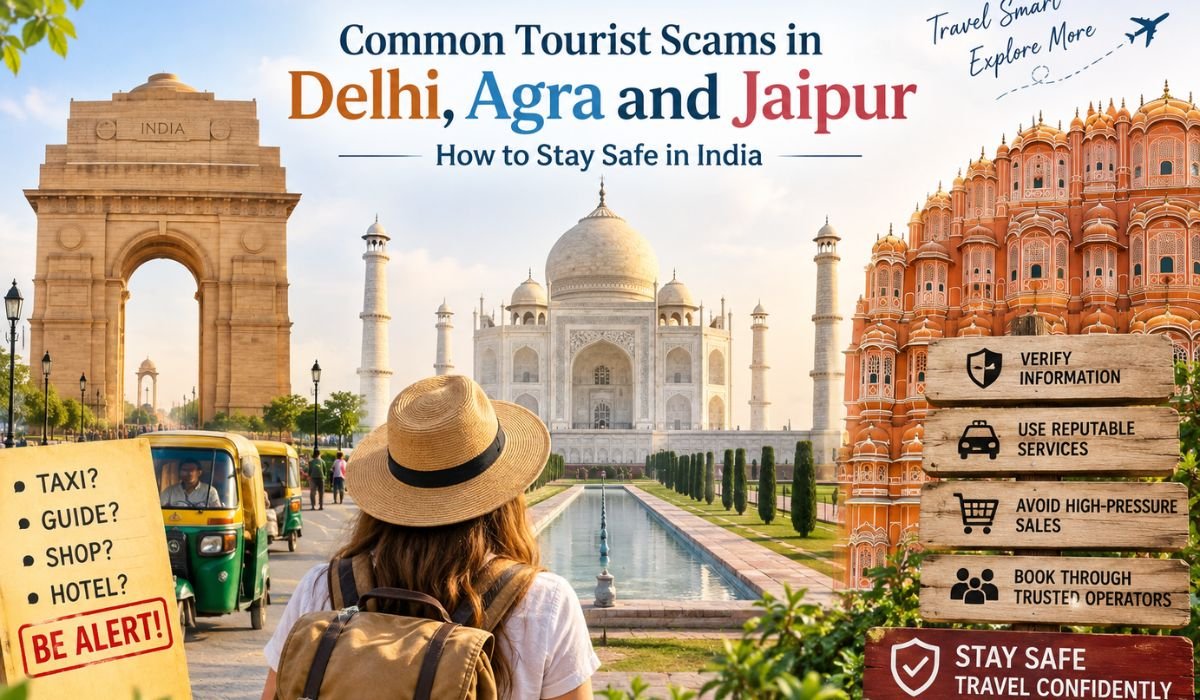
Delhi, Agra and Jaipur make up India’s classic Golden Triangle, and together they welcome more first-time visitors than almost any other travel circuit in the country. If you’re planning a trip here, the overwhelming likelihood is that everything goes smoothly — most travelers leave with nothing worse than tired feet and a phone full of photos.
That said, any place that sees millions of visitors a year will attract a small number of people looking to take advantage of newcomers, and Delhi, Agra and Jaipur are no different from major tourist hubs anywhere else in the world. The good news is that the most common tourist scams in Delhi, Agra and Jaipur tend to follow the same handful of patterns, aimed at the same knowledge gaps: unfamiliar prices, unfamiliar transport and a bit of travel fatigue.
Once you know what those patterns look like, they’re genuinely easy to spot and even easier to sidestep. This guide walks through the specific tactics you’re most likely to run into across the Golden Triangle, plus what to actually do about each one.
What are the most common tourist scams in Delhi, Agra and Jaipur?
Common issues include overpriced transportation, unofficial guides, misleading shopping recommendations, unclear ticket assistance, high-pressure sales tactics, and claims that a hotel or attraction is closed. Most are avoidable by confirming prices up front, using reputable services, and checking information independently rather than trusting unsolicited offers.
Why Tourists Are More Vulnerable to Scams
First-time visitors are easier targets not because they’re careless, but because they’re missing information a local takes for granted. A few common gaps:
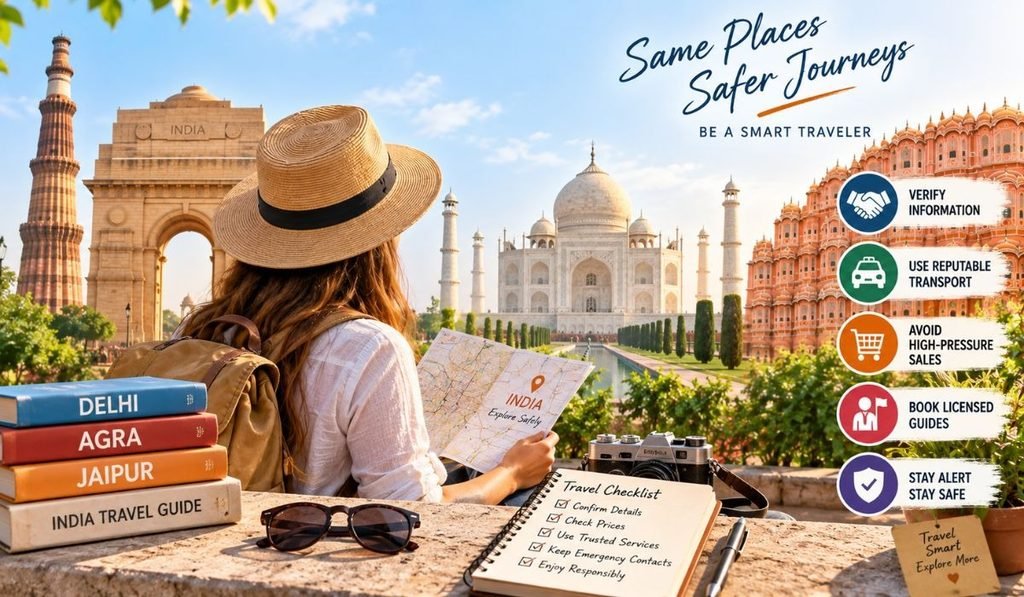
- Unfamiliar currency and unclear sense of what things “should” cost
- Not knowing which taxi or auto-rickshaw fares are reasonable
- Language barriers that make it harder to double-check details
- Uncertainty about an attraction’s real opening hours or ticket process
- No experience with India’s bargaining culture, where quoted prices are often a starting point
- Arriving tired at an airport or railway station, which is exactly when snap decisions happen
- A natural instinct to trust a friendly stranger who offers help unprompted
None of this means you should treat every driver, vendor or passerby with suspicion — the vast majority are simply doing their job. Being prepared is far more useful than being wary of everyone you meet.
Common Tourist Scams in Delhi
As the entry point for most Golden Triangle trips, Delhi is where many travelers encounter their first unsolicited “help.”
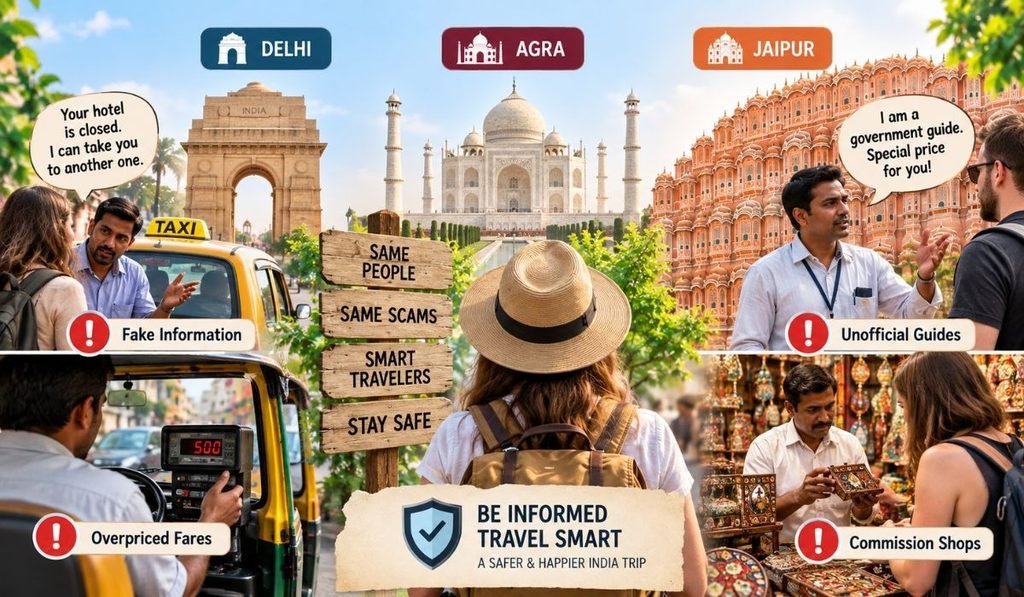
1. The “Your Hotel Is Closed” Scam
A driver, rickshaw operator or stranger tells you your hotel is closed, fully booked, unsafe or has “moved,” then offers to take you somewhere else instead — usually a place that pays them a commission.
How to avoid it: Confirm your hotel’s address and phone number before you arrive, and call the hotel directly if anyone claims otherwise. Ask the driver to take you to the exact address you booked, not wherever they suggest.
2. Overpriced Taxi and Auto-Rickshaw Fares
Unusually high quotes, vague pricing, or a route that seems to wind on much longer than it should are all common with drivers who assume you don’t know the area.
How to avoid it: Agree on a fare before the ride starts, or use a metered/app-based option where available. Keep your destination saved on your phone and have a rough sense of the distance beforehand.
3. The Fake Guide Scam
Unofficial guides often approach travelers right at the gates of major sites, claiming special authorization, offering unusually cheap tours, or promising “access” that doesn’t really exist — sometimes with the real goal of steering you toward a shopping stop afterward.
How to avoid it: Arrange a guide in advance through your hotel, a tour operator or another verified source, and ask to see identification before agreeing to anything. Golden Triangle Tour Packages — a well-organized option through a reputable operator — typically comes with licensed, government-certified local guides already built in, which removes this guesswork entirely.
4. The “Special Shop” or Commission Shopping Scam
A driver or guide insists they know a “government-approved” or “best price” shop for carpets, jewelry, textiles, handicrafts or marble souvenirs. Prices at these stops are often inflated because the person who brought you there earns a commission.
How to avoid it: You’re never obligated to buy anything. Compare prices at more than one shop, ask if you can see other options, and don’t mistake a driver’s enthusiasm for an official recommendation.
Common Tourist Scams in Agra
Agra’s economy revolves heavily around the Taj Mahal, which means the area around it sees a concentrated amount of tourism-focused activity.
5. Unofficial Guides Around the Taj Mahal
Similar to Delhi, unsolicited guides cluster near the entrance, sometimes offering “faster” entry, “secret” photo spots, or inflated flat fees decided on the spot.
How to avoid it: Check credentials, agree on a price in writing or by message beforehand, and consider booking a guide ahead of time through your tour provider or hotel.
6. “Taj Mahal Is Closed” or “You Can’t Enter Here” Claims
Confusion around entrance gates, ticket counters or security lines gets used to redirect travelers toward a shop, an “alternative” guide or an unofficial service.
How to avoid it: Verify anything about entry, tickets or hours through your hotel, tour operator or the site’s official channels — not through a stranger who approaches you outside the gate.
7. Fake or Inflated Souvenir Prices
Marble replicas, leather goods, jewelry and handicrafts are sold at a wide range of prices depending on where — and from whom — you buy.
How to avoid it: Bargaining is normal in most Indian markets, so decide on a price you’re comfortable with before you commit, rather than negotiating under pressure.
8. Rickshaw and Taxi Detour Scams
A driver quotes one price, then takes a longer route, adds an unplanned shop stop, or claims your actual destination is “inaccessible” by road.
How to avoid it: Confirm both the destination and the fare before you get in, and stick with drivers arranged through your hotel or a trusted transport service when possible.
Common Tourist Scams in Jaipur
Jaipur’s markets are a highlight of most Golden Triangle trips — they’re also where shopping-related pressure tends to be strongest.
9. Gemstone and Jewelry Scams
The pitch usually sounds something like an offer of a special “wholesale” price on gemstones. Without independent knowledge of quality, certification or fair market value, it’s very hard for a traveler to judge whether that price is actually good.
How to avoid it: Don’t buy expensive stones on impulse. Ask for independent certification, compare prices elsewhere, and treat high-pressure sales tactics as a signal to walk away, not a reason to hurry.
10. The “Government Emporium” or Special Discount Claim
Phrases like “government-approved,” “export quality” or “last-day discount” are used to make an offer sound more official or urgent than it is.
How to avoid it: Treat these claims as marketing language rather than fact, and verify anything that sounds official independently before you rely on it.
11. Pushy Shopping Stops During Tours
Sometimes an itinerary quietly includes stops at carpet, textile, jewelry or handicraft shops that weren’t part of the original plan.
How to avoid it: Before booking a private tour, ask directly whether shopping stops are included and whether they’re optional. A transparent operator will tell you upfront rather than surprising you mid-trip.
Scams That Can Happen Across Delhi, Agra and Jaipur
A few tactics show up everywhere in the Golden Triangle, not just in one city.
Fake currency or incorrect change — Count your change before walking away from a shop, taxi or counter, especially with larger notes.
“Free” gifts that aren’t really free — Flowers, bracelets, religious items or photos offered without a stated price sometimes come with a demand for payment afterward. Ask the price before accepting anything.
Fake charity requests — Emotional stories are occasionally used to pressure tourists into handing over cash on the spot. It’s fine to decline and donate through a verified organization instead if you’d like to help.
ATM or card-related pressure — Stick to ATMs attached to banks, cover your PIN, and check the amount on screen before confirming any transaction.
Fake booking or ticket assistance — Be cautious of anyone offering to “help” with bookings who asks you to hand over your passport, card or a large amount of cash directly.
How to Avoid Tourist Scams in India
Before your trip:
- Save your hotel’s address and phone number offline
- Research roughly what transport, meals and entry tickets should cost
- Keep a couple of emergency contacts easily accessible
- Learn the basic Indian currency denominations
- Save official information for the attractions you plan to visit
- Keep copies of your important travel documents, separate from the originals
During your trip:
- Confirm prices before agreeing to any service
- Give yourself time before making a purchase decision
- Treat unsolicited offers with mild caution, not automatic distrust
- Keep valuables secured and out of sight
- Avoid handing over your passport unless it’s genuinely required
- Trust your instincts if someone is pushing you to decide quickly
When booking a tour, look for:
- Clear, itemized inclusions and exclusions
- A transparent itinerary shared in advance
- Verified, recent reviews
- Vetted drivers and licensed guides
- Clear cancellation terms
- Accessible customer support before and during your trip
What to Do If You Think You’ve Been Scammed
Stay calm and avoid escalating the situation on the spot — most disputes are resolved more easily once emotions settle. Keep any receipts, messages or booking confirmations related to the incident.
Next, contact your hotel or tour operator, since they can often help resolve local issues quickly. If money or documents were involved, India’s national emergency number is 112, and the Ministry of Tourism runs a 24/7 multilingual tourist helpline at 1363 (or 1800-11-1363) for travel-related complaints and guidance. If a card was compromised, contact your bank immediately to freeze it.
Is Delhi, Agra and Jaipur Safe for Tourists?
Yes, in the sense that matters most: these are three of India’s most-visited destinations, and the vast majority of the millions of domestic and international travelers who pass through each year do so without incident. Tourist scams are a practical nuisance to plan around, not a reason to avoid the Golden Triangle altogether.
Preparation, reputable transportation and a bit of informed skepticism go a long way toward avoiding the avoidable problems. For a broader look at transportation, street safety and other practical concerns beyond scams, this Golden Triangle Tour guide covers it in more depth.
Should You Travel Independently or With a Private Tour?
There’s no single right answer — it depends on how much research and negotiation you want to handle yourself.
| Independent Travel | Private Tour |
| More flexibility | Pre-arranged transportation |
| Requires more research | Local assistance built in |
| You handle negotiations | Driver and guide support |
| More responsibility for logistics | Organized itinerary |
| Better suited to experienced travelers | Convenient for first-timers |
A private tour won’t make you completely scam-proof — nothing does — but having a reliable local contact, pre-arranged transport and verified guides removes a lot of the guesswork that scams typically rely on. If you’d rather not manage every logistic yourself, a Golden Triangle Tour Packages option can be a practical middle ground. Travelers who’d prefer more breathing room between sightseeing and transfers might also look at a Golden Triangle Tour 4 Days itinerary instead of rushing the circuit.
Quick Scam Checklist
- Confirm your hotel’s address and phone number before you land
- Agree on transport fares before the ride starts
- Book guides in advance through a verified source
- Never treat a driver’s shop recommendation as an official one
- Get independent certification before buying gemstones or jewelry
- Ask the price before accepting any “free” gift
- Verify attraction hours and entry rules through official channels
- Count your change and protect your ATM PIN
- Keep your passport secure and avoid handing it over unnecessarily
- Trust your gut if someone is rushing your decision
Final Thoughts
Once you know what to watch for, you can spend a lot less energy worrying and a lot more time enjoying the parts of India you actually came to see. If it helps to have the logistics handled for you, it’s worth taking the time to plan a Golden Triangle Tour around the sights that matter most to you, rather than figuring everything out on the fly.
Planning your Delhi–Agra–Jaipur trip? Once you know how to recognize common tourist scams, the Golden Triangle becomes much easier to navigate. Take a look at the available Golden Triangle Tour Packages and choose an itinerary that matches your travel time, comfort level and sightseeing priorities.