


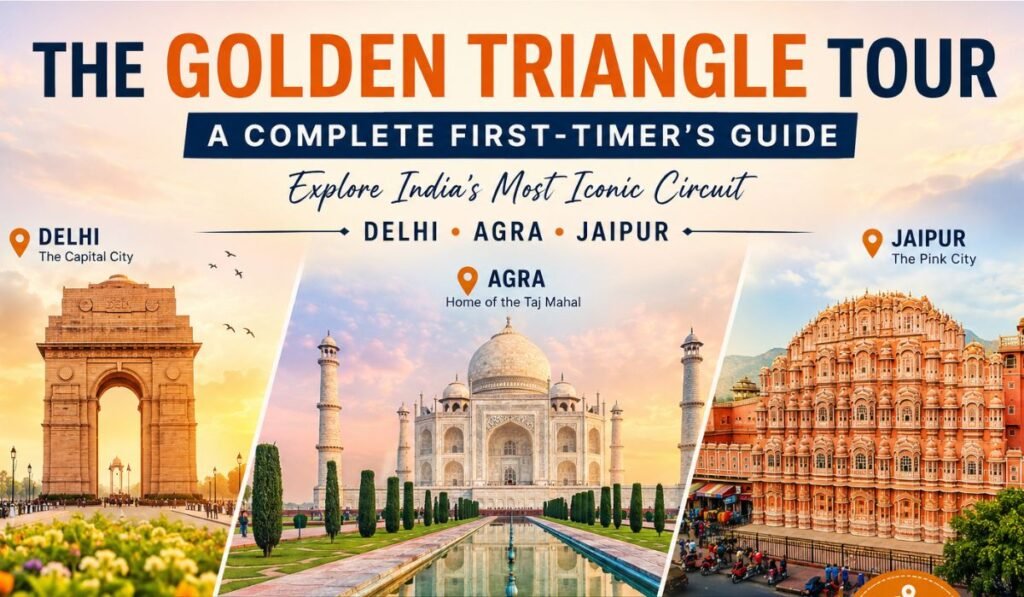
If you’re standing at the start of your India planning journey with one phrase stuck in your head — “Golden Triangle Tour” — you’re in good company. It’s the route nearly every first-time visitor to India ends up taking, and for good reason. This guide walks you through it the way a well-traveled friend would: honestly, practically, and without the fluff you’ll find on a dozen other sites.
If you’re short on time, our Golden Triangle Tour 3 Days itinerary covers the highlights, while travelers seeking a more relaxed experience can explore our Golden Triangle Tour 5 Days guide.
Quick Facts: Golden Triangle Tour at a Glance
| Detail | Information |
| Cities Covered | Delhi, Agra, Jaipur |
| Typical Duration | 4–7 days |
| Best Season | October to March |
| Distance (Loop) | Roughly 720 km total |
| Main Draw | Taj Mahal, Amber Fort, Red Fort, Hawa Mahal |
| Tour Styles | Private, group, luxury, budget, self-drive |
| Ideal For | First-time visitors, families, couples, solo travelers |
| Visa Needed | Yes, e-Visa available for most nationalities |
What Is the Golden Triangle Tour, and Why Is It So Famous?
The Golden Triangle Tour connects Delhi, Agra, and Jaipur in a triangular route, giving travelers a condensed but powerful introduction to Mughal architecture, Rajput heritage, and modern Indian life in a single trip. It’s famous because these three cities pack in three UNESCO World Heritage Sites and centuries of history without requiring long-haul internal flights.
What it is: A circuit linking India’s capital (Delhi), the city of the Taj Mahal (Agra), and the “Pink City” of Rajasthan (Jaipur). The triangle shape on a map is where the name comes from — not gold, despite what some assume.
Why it’s famous: Each city anchors a different chapter of Indian history. Delhi shows you Mughal and colonial-era Delhi side by side. Agra holds the Taj Mahal and Agra Fort. Jaipur introduces you to Rajasthani forts, palaces, and bazaars. Few regions in the world let you cover this much ground — historically and geographically — in under a week.
Where: Northern India, in the state cluster of Delhi (NCT), Uttar Pradesh (Agra), and Rajasthan (Jaipur).
When: Year-round, though comfort varies dramatically by season (more on that below).
How: Most travelers go by private car with driver, train, or a mix of both. Distances are manageable by road, which is part of why this route became so popular in the first place.
Travel time: Delhi to Agra is about 3–4 hours by road or roughly 2 hours by the Gatimaan/Vande Bharat express trains. Agra to Jaipur is around 5 hours by road.
Pro tip: Most people only plan for the headline monuments. Build in one genuinely unstructured half-day in each city — no monument, no checklist — just to wander a market or sit in a café. It’s almost always the part travelers remember most fondly afterward.
Who Is This Tour Suitable For?
Families and first-time visitors often find a Golden Triangle Tour 4 Days itinerary offers the perfect balance between sightseeing and comfortable travel without feeling rushed.
- First-time visitors wanting an efficient introduction to India
- Couples and honeymooners (Agra in particular leans romantic)
- Families with children of most ages, with some itinerary tweaks
- Solo travelers, especially with a private driver setup
- History and architecture enthusiasts
- Photographers chasing golden-hour shots of the Taj
It’s less ideal for travelers seeking deep wildlife experiences, beach time, or a slow, single-destination immersion — though add-ons (like Ranthambore for tigers, or Pushkar for a quieter Rajasthan stop) can extend the loop if that’s what you’re after.
How Many Days Do You Need, and What Should Your Itinerary Look Like?
Most travelers spend between 4 and 7 days on the Golden Triangle, with 5–6 days hitting the sweet spot between depth and pace. Anything under 4 days turns the trip into a monument sprint; 7+ days lets you add Ranthambore, Pushkar, or a slower pace in each city.
What: A day-by-day plan balancing travel time against sightseeing time, since road distances (not flight time) shape your days here.
Why this matters: Underestimating travel time is the single biggest itinerary mistake. A 5-hour drive eats your afternoon — plan around it, don’t fight it.
Sample 6-Day Itinerary
| Day | City | Highlights | Pace |
| 1 | Delhi | Red Fort, Jama Masjid, Chandni Chowk, India Gate | Full day |
| 2 | Delhi → Agra | Drive/train, Agra Fort, evening at leisure | Travel + half day |
| 3 | Agra → Jaipur | Sunrise Taj Mahal, drive to Jaipur via Fatehpur Sikri | Early start, travel day |
| 4 | Jaipur | Amber Fort, City Palace, Hawa Mahal, Jantar Mantar | Full day |
| 5 | Jaipur | Local bazaars, optional Nahargarh sunset, free time | Relaxed day |
| 6 | Jaipur → Delhi | Return drive/train, departure | Travel day |
Pro tip: See the Taj Mahal at sunrise, not midday. The light is softer, the crowds are thinner, and the marble’s color shift through the morning is something photos rarely capture properly until you’ve seen it yourself.
Common mistake: Skipping Fatehpur Sikri because it’s “just a ruin.” It’s a near-complete Mughal city, often emptier than the Taj, and sits right on the Agra–Jaipur road — skipping it saves no real time.
Cost consideration: Compressing the trip into 4 days usually means more highway hours and less buffer for traffic, monument closures (Taj Mahal is closed Fridays), or simply slowing down when something catches your interest.
Travelers who enjoy slower-paced holidays often prefer our Golden Triangle Tour 7 Days, which includes additional time for cultural experiences, local cuisine, and optional excursions.
Getting Around: Transportation Options Compared
Transportation on the Golden Triangle route generally means choosing between a private car with driver, train travel between cities, or a self-drive rental — each with different costs, comfort levels, and flexibility.
What: Three realistic ways to move between Delhi, Agra, and Jaipur: private car, train, or self-drive.
Why it matters: Your transport choice affects not just cost, but how much you actually see along the way — roadside stops, small towns, and unplanned detours are only possible by road.
| Mode | Best For | Approx. Cost (Delhi–Agra–Jaipur loop) | Comfort | Flexibility |
| Private car + driver | Most travelers | ₹8,000–₹14,000 total | High | High |
| Train (AC class) | Budget + speed on Delhi-Agra leg | ₹500–₹1,500 per leg | Moderate-High | Low |
| Self-drive rental | Confident, experienced drivers | ₹3,000–₹6,000/day | Variable | Highest, but stressful |
| Tourist bus/coach | Budget group travelers | ₹1,500–₹3,000 per leg | Moderate | Low |
Pro tip: Indian driving norms differ significantly from Western countries — lane discipline is loose, horns are communicative rather than aggressive, and night driving on highways is best avoided. A hired driver isn’t a luxury here; it’s the practical choice for most visitors.
Common mistake: Booking the Agra–Jaipur leg by an ordinary highway taxi without checking the route via Fatehpur Sikri — some drivers default to a faster bypass that skips it entirely unless you ask in advance.
Where to Stay: Accommodation by Budget Level
Accommodation along the Golden Triangle ranges from heritage havelis and five-star palace hotels to clean, well-rated budget guesthouses, with most travelers finding the best value in India’s strong mid-range hotel segment.
What: Lodging options across three price tiers in each city.
Where: Look for hotels near Connaught Place or South Delhi in Delhi; near Fatehabad Road in Agra for Taj views; and near Civil Lines or the Pink City core in Jaipur.
| Budget Tier | Per Night (Avg.) | What to Expect |
| Budget | ₹1,500–₹3,000 | Clean, simple, often local-run guesthouses |
| Mid-range | ₹4,000–₹8,000 | Branded hotels, good amenities, reliable Wi-Fi |
| Luxury | ₹12,000–₹40,000+ | Heritage palaces, 5-star service, Taj-view rooms |
Pro tip: In Agra specifically, paying extra for a “Taj-view room” is sometimes worth it for the rooftop or balcony sunrise view alone — check recent guest photos before booking, since “Taj view” can mean anything from a clear vista to a sliver between buildings.
Common mistake: Booking hotels far from each city’s old quarter to save money, then losing hours daily to traffic. In Jaipur and Delhi especially, location often matters more than star rating.
Budgeting Your Trip: What Things Actually Cost
A realistic Golden Triangle budget depends heavily on travel style, but most independent travelers spend between ₹3,000 and ₹8,000 per day per person once accommodation, transport, food, and entry fees are combined.
Sample Daily Budget (Mid-Range Traveler)
| Expense | Approx. Cost (per person/day) |
| Accommodation | ₹3,000–₹5,000 (shared) |
| Meals | ₹800–₹1,500 |
| Monument entry fees | ₹500–₹1,500 (varies by site) |
| Local transport | ₹500–₹1,000 |
| Shopping/extras | Variable |
Pro tip: Foreign-national entry tickets for monuments like the Taj Mahal and Amber Fort cost significantly more than domestic tickets — this is standard policy, not a tourist markup, and it’s worth budgeting for rather than being caught off guard.
Common mistake: Forgetting that many forts and palaces charge separately for camera/video use, audio guides, or specific inner sections (like the Taj Mahal’s mausoleum platform). These add up across three cities.
Note on pricing: Entry fees, train fares, and hotel rates change periodically. Always confirm current prices through official tourism websites or your accommodation before finalizing your budget.
Best Time to Visit: Seasonal Planning
The Golden Triangle is most comfortable between October and March, when daytime temperatures sit in a manageable range; the April–June stretch brings intense heat, while monsoon months (July–September) bring humidity and occasional travel disruptions.
| Season | Months | Temp Range | Crowd Level | Notes |
| Winter (Peak) | Oct–Feb | 8–25°C | High | Best comfort, book ahead |
| Early Summer | Mar–Apr | 20–35°C | Moderate | Still workable, mornings best |
| Summer | May–Jun | 35–46°C | Low | Brutal heat, early starts essential |
| Monsoon | Jul–Sep | 27–35°C | Low | Lush scenery, but humid and unpredictable |
Pro tip: December and January mornings in Agra and Delhi can bring thick fog that delays both flights and the famous Taj sunrise view — if you’re traveling in peak winter, build a buffer day into your itinerary rather than scheduling the Taj for your only morning there.
Common mistake: Visiting in May or June without adjusting the itinerary — sightseeing needs to start by 6–7 AM and pause through the brutal afternoon hours, which many first-time planners don’t account for.
What to Pack: A Practical Checklist
Packing for the Golden Triangle means balancing modest dress for religious and heritage sites, layered clothing for temperature swings, and comfort for a lot of walking on uneven, sun-exposed stone surfaces.
Travel Checklist
- Lightweight, breathable clothing that covers shoulders and knees (for temples/mosques)
- A light shawl or scarf (useful for both modesty and sun protection)
- Comfortable, closed-toe walking shoes
- Sunscreen and a wide-brimmed hat
- Reusable water bottle with a filter (tap water isn’t drinking-safe)
- Power adapter (Type C/D/M, 230V)
- Hand sanitizer and tissues (many public restrooms lack supplies)
- A printed/digital copy of your e-Visa and hotel bookings
- Cash in small denominations for entry tickets and tips
- A dedicated day bag for sightseeing (lockers aren’t always available)
Pro tip: Socks matter more than people expect — several temples and forts (including sections of the Taj complex) require you to remove shoes, and the marble or stone underfoot can be scorching by mid-morning in warmer months.
Photography Tips Most Guides Skip
Photographing the Golden Triangle well is less about gear and more about timing, angles, and knowing which spots get crowded fastest — small adjustments that make a real difference in your final shots.
- Taj Mahal: Arrive at gate-opening time and head toward the side gardens first; the classic front-facing bench shot draws a long queue within the first hour.
- Amber Fort: Shoot from the Jaigarh Fort viewpoint above for a wide shot of Amber’s full silhouette against the hills — most visitors never look beyond the fort’s own courtyards.
- Hawa Mahal: The honeycomb façade photographs best from the small café terraces directly across the street in the early morning, before the street fills with traffic.
- Chandni Chowk: Use a fast shutter and shoot from hip height in the bazaar lanes; tripods and obvious “tourist photography” setups can attract unwanted attention in the crowd.
- General: Overcast days in winter actually flatter sandstone monuments — harsh midday sun washes out detail that softer light reveals.
Lesser-Known Attractions Worth Your Time
Beyond the headline monuments, a handful of nearby sites offer comparable beauty with a fraction of the crowds.
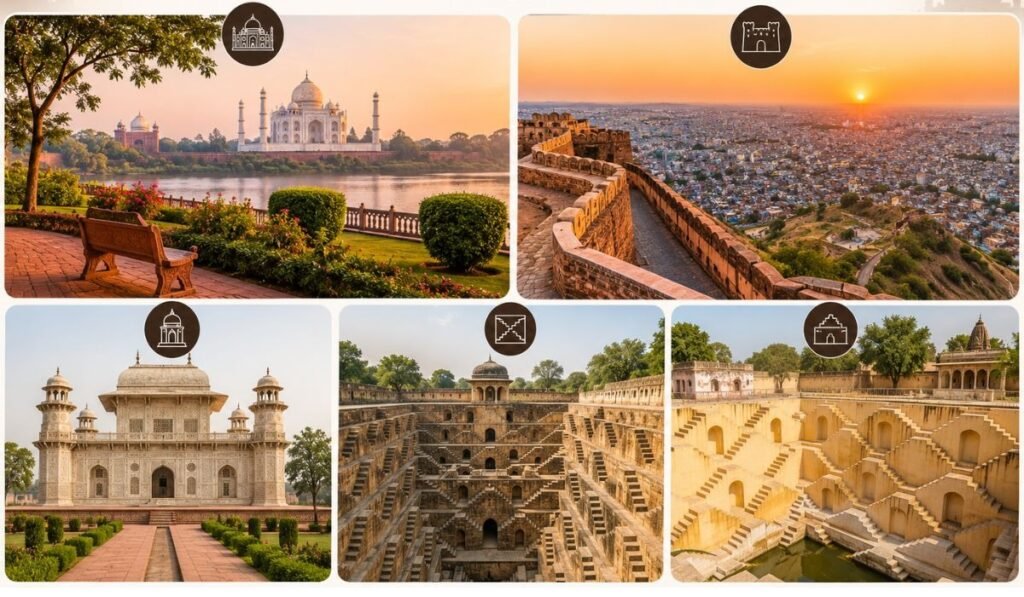
| Attraction | City/Area | Why It’s Worth Adding |
| Mehtab Bagh | Agra | Taj views from across the river, far fewer crowds |
| Nahargarh Fort | Jaipur | Sunset views over the entire Pink City |
| Tomb of I’timad-ud-Daulah | Agra | A smaller, often-empty precursor to Taj design |
| Abhaneri Stepwell | Between Jaipur/Agra | Striking geometric stepwell, rarely visited |
| Panna Meena ka Kund | Jaipur | Photogenic stepwell minutes from Amber Fort |
Pro tip: Mehtab Bagh at sunset gives you the Taj Mahal glowing in golden light from across the Yamuna River — and you’ll likely share the space with a fraction of the people at the main complex.
Common Tourist Mistakes (and How to Avoid Them)
- Rushing the Taj Mahal. Budget at least 90 minutes, ideally at sunrise.
- Skipping hydration and sun protection. Heat exhaustion is a real risk outside winter months.
- Not confirming the Taj Mahal’s Friday closure before building it into a fixed itinerary.
- Overpaying unlicensed “guides” who approach near monument entrances. Book guides through your hotel or a verified tour provider instead.
- Ignoring bargaining norms in markets, then feeling cheated afterward. A little research on fair local pricing goes a long way.
- Underestimating road travel time, especially Agra to Jaipur, which can stretch with traffic or weather.
- Not carrying small cash, since many monument ticket counters and rural stops don’t take cards reliably.
Choosing Your Tour Type: Private, Group, Luxury, or Budget
There’s no single “right” way to do the Golden Triangle — the best choice depends on your budget, group size, and how much flexibility you want day-to-day. Here’s a neutral breakdown to help you decide.
Private vs. Group Tours
| Factor | Private Tour | Group Tour |
| Flexibility | High — set your own pace | Low — fixed schedule |
| Cost per person | Higher | Lower |
| Social experience | Limited to your group | Meet fellow travelers |
| Customization | Full control over stops | Pre-set itinerary |
| Best for | Couples, families, solo travelers wanting flexibility | Budget-conscious travelers, those who enjoy group dynamics |
Luxury vs. Budget Travel
Pros of Luxury Travel: Heritage palace stays, dedicated guides, premium vehicles, fewer logistical headaches.
Cons of Luxury Travel: Significantly higher cost; can feel insulated from everyday local life.
Pros of Budget Travel: More authentic street-level experience, lower cost, easier to extend trip duration.
Cons of Budget Travel: More self-coordination required; comfort trade-offs on long travel days.
Family-Friendly Itineraries
Families generally do best with a slightly slower pace — fewer monuments per day, more buffer time, and accommodation with pools or green space for downtime. Jaipur in particular offers family-friendly experiences like elephant sanctuaries (choose ethically-run ones) and puppet shows.
Customized Travel Planning
Many travelers eventually realize that a fully custom itinerary — built around their specific interests, pace, and budget — beats both rigid group tours and DIY planning from scratch. If you’d rather hand off the logistics while keeping full input into the plan, working with a specialist like India Golden Triangle Tours for customized planning is a practical way to combine flexibility with local expertise, rather than trying to reverse-engineer the perfect route yourself.
Whichever path you choose, it’s worth comparing a few Golden Triangle Tour Packages side by side before booking, since inclusions (guides, entry fees, meals) vary more between providers than the headline price suggests.
Key Takeaways
- The Golden Triangle connects Delhi, Agra, and Jaipur in a manageable, history-rich loop.
- 5–6 days is the sweet spot for pacing; under 4 days tends to feel rushed.
- October to March offers the most comfortable weather for sightseeing.
- Private cars offer the most flexibility; trains are faster for the Delhi-Agra leg.
- Sunrise visits, off-the-checklist spots, and small planning buffers consistently improve the experience.
- Comparing Golden Triangle Tour Packages from a few providers helps you understand true inclusions before booking.
Frequently Asked Questions
1. Is the Golden Triangle Tour suitable for first-time visitors to India?
Yes — it’s specifically designed around manageable distances and major historical sites, making it one of the most approachable introductions to the country.
2. How many days are ideal for the Golden Triangle Tour?
Most travelers find 5–6 days ideal; 4 days is workable but rushed, and 7+ days allows for nearby add-ons like Ranthambore or Pushkar.
3. Is it better to travel by car or train between cities?
Both work well. Trains are faster and more predictable for Delhi-Agra; private cars offer more flexibility and the option to stop at sites like Fatehpur Sikri along the way.
4. Is the Taj Mahal open every day?
No — the Taj Mahal is closed on Fridays. Always confirm current opening days and hours through official sources before finalizing your itinerary.
5. Do I need a visa for India?
Most nationalities require a visa, and an e-Visa is available for many countries. Requirements change periodically, so confirm current rules through your country’s official India visa portal.
6. Is the Golden Triangle safe for solo travelers?
Generally yes, especially with a private driver and reputable accommodation. As with any destination, standard precautions around belongings, transport, and late-night travel apply.
Planning With Confidence
The Golden Triangle Tour rewards a bit of upfront planning more than almost any other route in India — not because it’s complicated, but because small choices (when you visit the Taj, how you get between cities, how many days you allow) shape the experience more than people expect. Use the breakdowns above to build a pace that suits you, double-check current prices and hours through official sources closer to your travel dates, and you’ll be well set up for a trip that feels considered rather than rushed.


Pingback: Luxury vs Budget Golden Triangle Tour: Which Is Better?
Pingback: Tourist Scams in Delhi, Agra & Jaipur: Stay Safe