



Golden Triangle hidden gems are the stepwells, gardens, tombs, viewpoints and neighborhoods that sit just outside the standard Delhi–Agra–Jaipur sightseeing route. They aren’t secret in the literal sense — most have names, addresses and entry tickets — but they rarely make it onto a first-time itinerary built around the Taj Mahal, Red Fort, Amber Fort and Hawa Mahal.
Delhi, Agra and Jaipur are famous for good reason. Their headline monuments are genuinely extraordinary. But travelers who set aside even half a day to move beyond that circuit find a quieter, more textured side of the region: Mughal-era gardens, geometric stepwells, layered archaeological parks, old bazaar lanes and hilltop temples that rarely appear in a rushed two- or three-day trip. This guide is less a “secret places” list and more a practical way to plan your time so those experiences fit alongside — not instead of — the monuments you came to see.
What Makes a Place a Golden Triangle Hidden Gem?
“Hidden gem” is a travel-content term, not an official classification, and it’s worth being precise about what it actually means here. In the Golden Triangle, it usually describes one of five things:
- Completely unknown places with almost no visitor footfall
- Lesser-visited historical attractions that are well documented but skipped due to time constraints
- Sites located slightly off the main tourist route, requiring a short detour or extra planning
- Cultural experiences — markets, walks, food, festivals — that short itineraries simply don’t have room for
- Alternative viewpoints of monuments most people only see from the standard vantage point
Being upfront about this distinction matters. A place like Fatehpur Sikri, for instance, isn’t unknown — it’s a UNESCO World Heritage Site — but it’s genuinely underexplored compared with the Taj Mahal, which is why it still belongs on a “beyond the obvious” list.
Hidden Gems in Delhi
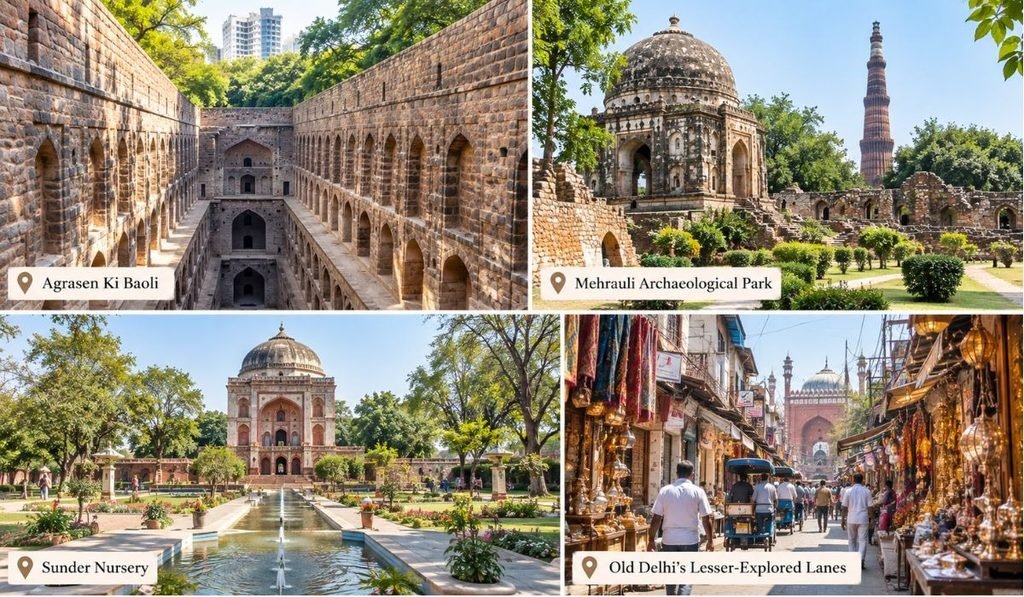
Agrasen Ki Baoli
Tucked away near Connaught Place, Agrasen Ki Baoli is a historic stepwell. Its exact origins are debated. Most historians link its current form to the 14th-century rebuilding of an older structure. The stepwell has 108 steps. They descend between high stone walls lined with arched niches. The design creates a striking play of light and shadow. Photographers often visit in the late morning to capture this effect.
Agrasen Ki Baoli is easy to miss because of its location. It sits along a narrow lane just off a major commercial road. There is no large façade to signal its presence from the street. The stepwell is centrally located and free to enter. This makes it easy to include in a Delhi day trip. You can also combine it with Connaught Place shopping or a visit to nearby Jantar Mantar.
Mehrauli Archaeological Park
This park compresses centuries of Delhi’s layered history into a single walkable green space — medieval tombs, stepwells, mosques and ruins from multiple dynasties sit within a few hundred meters of each other, many with no formal signage. It’s one of the few places in Delhi where you can see Lodi-era, Tughlaq-era and colonial-period structures side by side.
Because it isn’t a single monument but a scattered park, it demands more time and a bit of self-directed exploration, which is exactly why bus-tour itineraries tend to skip it. For travelers interested in Delhi’s history beyond the Red Fort and Qutub Minar, it offers a different, less curated perspective on the city.
Sunder Nursery
Once a nursery for the Archaeological Survey of India, this heritage park near Humayun’s Tomb has been restored into a landscaped garden built around several Mughal-era structures, including tombs and pavilions. It’s a calmer, greener counterpoint to monument-heavy sightseeing — a place to walk slowly rather than tick off a checklist.
The combination of restored architecture, water channels and open lawns makes it popular with photographers and families alike, and it pairs naturally with a Humayun’s Tomb visit since the two sites are adjacent.
Old Delhi’s Lesser-Explored Lanes
Beyond the popular routes to Jama Masjid and Chandni Chowk, Old Delhi has much more to explore. Its narrow lanes are home to traditional spice and fabric markets. You will also find centuries-old havelis and street food that rarely appears on tourist maps.
The experience is not just about finding hidden places in Delhi. It is about exploring the architecture of these historic lanes. You can also experience the rhythm of daily trade and discover food traditions passed down through generations of vendors.
Exploring these offbeat places in Delhi is easier with a local guide or walking tour. The lanes are dense and often have limited English signage. Without local knowledge, it can be easy to lose your way.
Hidden Gems in Agra Beyond the Taj Mahal
Agra is often known for a single monument: the Taj Mahal. However, the city’s Mughal-era heritage extends far beyond the Taj. Travelers who have already visited the monument can discover a different side of Agra through these historic sites.
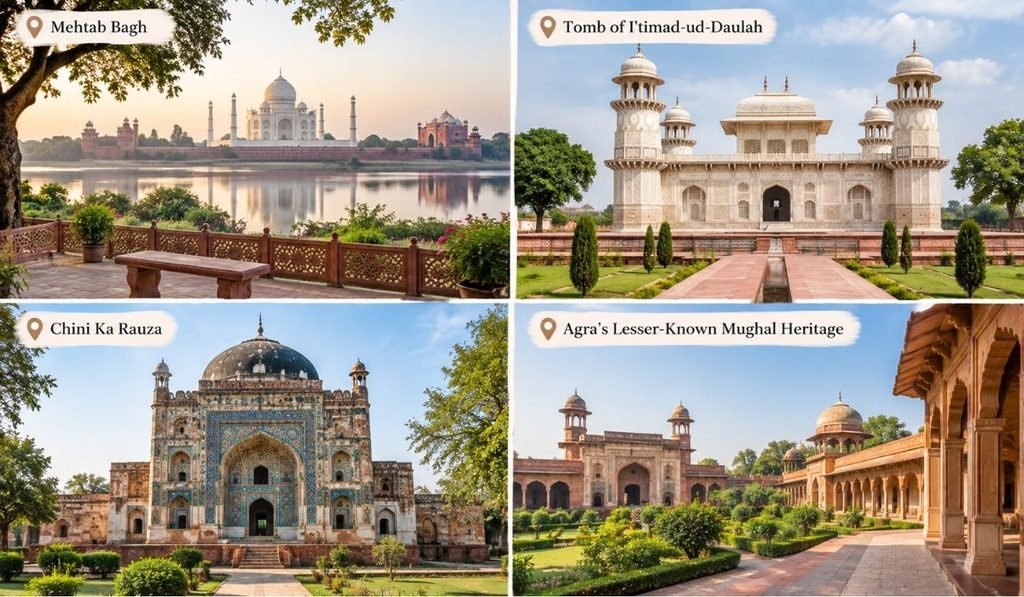
Mehtab Bagh
Directly across the Yamuna River from the Taj Mahal, Mehtab Bagh is a historic Mughal charbagh, or four-part garden. It is believed to have been designed as a moonlit viewing spot for the mausoleum. Today, the garden offers one of the most photographed alternative views of the Taj Mahal. The view is especially beautiful at sunset. The monument’s white marble catches the warm light across the river.
It draws far fewer visitors than the main complex, making it a good option for travelers who want a quieter vantage point without giving up a clear view of the monument itself.
Tomb of I’timad-ud-Daulah
Often called the “Baby Taj,” this tomb was built before the Taj Mahal. It is considered an important precursor to Mughal architectural development.
Its marble facade features intricate pietra dura inlay work. This technique uses semi-precious stones set into marble to create floral and geometric patterns. The technique was later refined and used extensively at the Taj Mahal.
Because it’s smaller in scale and located across the river from Agra’s main monument cluster, it tends to see a fraction of the footfall, despite its architectural and historical significance.
Chini Ka Rauza
This riverside tomb shows a strong Persian architectural influence. The glazed tile decoration is one of its most distinctive features. This technique is uncommon among Agra’s other Mughal monuments.
Much of the original tilework has faded over time. This may be one reason the tomb receives less attention than better-preserved sites. However, the surviving sections still offer a glimpse of how colorful and vivid the original structure may have been.
Agra’s Lesser-Known Mughal Heritage
Together, Mehtab Bagh, I’timad-ud-Daulah, and Chini Ka Rauza offer a broader view of Agra’s Mughal heritage. These sites reveal a history of architectural experimentation, Persian influence, and riverside planning. Their history began long before the Taj Mahal was built and continued long after its construction. If you want to explore this side of Agra, these sites are worth adding to your itinerary.
Hidden Gems in Jaipur
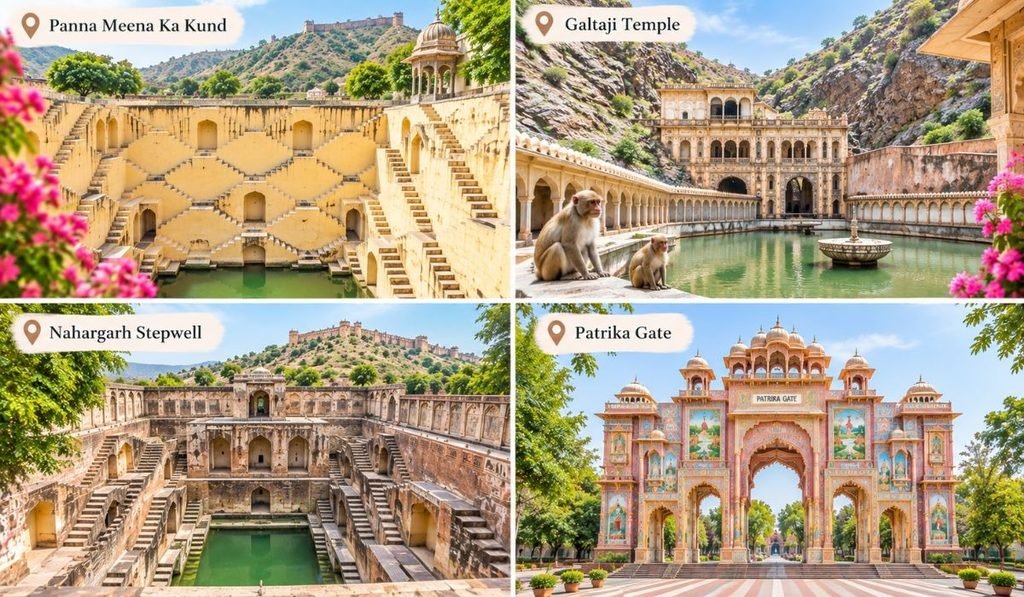
Panna Meena Ka Kund
A few minutes from Amber Fort, this stepwell is built with a striking double-staircase, symmetrical design that creates a hypnotic geometric pattern when viewed from above. Because it sits so close to one of Rajasthan’s most-visited forts, it’s easy to add on without extending your day significantly — most travelers combine the two in a single stop.
Galtaji Temple
Set in a narrow gorge in the Aravalli hills outside Jaipur, Galtaji is a pilgrimage site built around natural spring-fed water tanks considered sacred by Hindu pilgrims. The temple complex, surrounded by hills and forest, offers a very different landscape from Jaipur’s urban palaces and forts, along with genuine religious and cultural significance for visitors interested in more than architecture alone.
Nahargarh Stepwell
Located near Nahargarh Fort, this stepwell appeals particularly to travelers already interested in architecture and lesser-known Jaipur heritage — it shares the geometric drama of Chand Baori and Panna Meena Ka Kund on a smaller, more intimate scale, with far fewer crowds.
Patrika Gate
Patrika Gate is one of Jaipur’s newer landmarks. Its elaborately painted arches showcase Rajasthani artwork and regional cultural motifs. It’s worth being honest here: this isn’t a well-kept secret anymore — it has become genuinely popular on social media — but it still doesn’t make it onto most standard sightseeing itineraries, which tend to focus on the City Palace, Amber Fort and Hawa Mahal.
Hidden Gems Between Agra and Jaipur
Some of the most rewarding stops aren’t in Delhi, Agra or Jaipur at all — they’re along the road connecting them.
Chand Baori at Abhaneri
Located roughly midway between Agra and Jaipur, Chand Baori is one of India’s largest and deepest stepwells, with over 3,500 narrow steps arranged in a precise geometric pattern across 13 stories. Its scale and symmetry make it one of the most photographed stepwells in the country, and its location makes it a natural route stop rather than a dedicated day trip.
Fatehpur Sikri
Rather than describe Fatehpur Sikri as hidden — it’s a UNESCO World Heritage Site with a well-established visitor base — it’s more accurate to call it a less-explored experience relative to the Taj Mahal and Jaipur’s headline attractions. This short-lived Mughal capital includes the Buland Darwaza (one of the tallest gateways in the world), Jama Masjid, and the Panch Mahal, a five-story palace built for cooling breezes rather than defense. Its abandoned-capital atmosphere gives it a very different feel from Agra’s better-known sites.
Hidden Experiences Are Not Always Hidden Places
Not every offbeat Golden Triangle experience has an address. Some of the most memorable ways to see the region’s lesser-known side come from what you do, not just where you go:
- Local food walks through neighborhood markets
- Traditional bazaars for textiles, jewelry and handicrafts
- Heritage walks led by local guides
- Sunrise or sunset viewpoints away from the main crowds
- Regional cuisine at family-run restaurants
- Village experiences on the outskirts of the main cities
- Architecture-focused photography walks
- Local festivals, when travel dates happen to coincide
These experiences round out a trip in ways that a checklist of stepwells and tombs alone can’t, and they’re often what travelers remember most clearly afterward.
How to Add Hidden Gems to a Golden Triangle Itinerary
How much offbeat exploration you can realistically fit in depends almost entirely on how many days you have.
If You Have 3 Days
With only three days to explore Delhi, Agra, and Jaipur, there is little time for detours. Focus on a few carefully selected experiences instead of trying to visit every place on this list. Adding one stop like Agrasen Ki Baoli in Delhi or Mehtab Bagh in Agra is realistic; trying to add five is not. Our 3-day Golden Triangle itinerary is built around this kind of pacing.
If You Have 4–5 Days
An extra day or two changes the equation meaningfully. It allows you to slow down in each city, add a stepwell or garden without rushing the main monuments, and build in a food walk or market visit that a tighter schedule wouldn’t allow. Our Golden Triangle Tour 5 Days itinerary is designed with this extra breathing room in mind, and a 4-day version is also available for travelers in between.
If You Have 6–7 Days
With a week, you can comfortably combine the classic Golden Triangle with a genuinely offbeat layer — stepwells between cities, Fatehpur Sikri as a proper stop rather than a rushed detour, and a day given over to markets, food and local culture. A longer itinerary gives you more time to explore attractions that shorter trips may not allow.
How to Plan a Hidden-Gem Golden Triangle Tour
A few practical habits make offbeat sightseeing work smoothly rather than derailing your day:
- Start early to beat both heat and crowds
- Group attractions geographically to minimize backtracking
- Avoid overloading any single day with too many stops
- Allow extra travel time for sites slightly off the main route
- Check opening days and timings in advance, since some sites close weekly
- Carry water and sun protection, especially outside the cooler months
- Respect religious sites by following posted etiquette
- Dress modestly where required, particularly at temples
- Use a knowledgeable local guide for historical context that signage often lacks
- Keep some flexible time in the itinerary for spontaneous stops
Best Time to Explore Golden Triangle Hidden Gems
October–March brings the most comfortable sightseeing conditions of the year, with cooler temperatures that make walking through stepwells, gardens and archaeological parks far more pleasant than in peak summer.
April–June turns considerably hotter across all three cities, so early-morning starts become important for outdoor sites like Mehrauli Archaeological Park or Galtaji Temple.
July–September brings the monsoon, with greener landscapes but a higher chance of rain-related disruptions, particularly at open-air stepwells and hillside temples. As with most seasonal travel advice, conditions vary year to year, so it’s worth checking a current forecast rather than relying on general seasonal patterns alone.
Hidden Gems vs Famous Golden Triangle Attractions
| Famous Attraction | Lesser-Known Alternative |
| Taj Mahal | Mehtab Bagh / Tomb of I’timad-ud-Daulah |
| Amber Fort | Panna Meena Ka Kund |
| Hawa Mahal | Patrika Gate |
| Central Delhi monuments | Mehrauli Archaeological Park |
| Main Jaipur attractions | Nahargarh Stepwell |
| Standard Agra route | Chini Ka Rauza |
How Many Hidden Gems Should You Add to One Trip?
As a practical guideline:
- 3 days: 2–3 lesser-known stops
- 4–5 days: 4–6 stops
- 6–7 days: 6–8 stops, depending on your interests
The goal isn’t to collect as many attractions as possible — it’s to add depth to the places that matter most to you, whether that’s architecture, history, food or photography.
Frequently Asked Questions About Golden Triangle Hidden Gems
What are the hidden gems of the Golden Triangle?
They include lesser-known stepwells, tombs, gardens and viewpoints across Delhi, Agra and Jaipur — places like Agrasen Ki Baoli, Mehtab Bagh, Panna Meena Ka Kund and Chand Baori — along with cultural experiences such as food walks and local markets that most standard itineraries skip.
What are some lesser-known places in Delhi?
Agrasen Ki Baoli, Mehrauli Archaeological Park and Sunder Nursery are among Delhi’s most notable lesser-known sites. Each offers a different angle on the city’s layered history, from medieval stepwells to Mughal-era gardens, without the crowds found at Red Fort or Qutub Minar.
What can I visit in Agra besides the Taj Mahal?
Beyond the Taj, Agra offers Mehtab Bagh for an alternative river-facing view, the Tomb of I’timad-ud-Daulah for its marble inlay work, and Chini Ka Rauza for its Persian-influenced tilework. Together they give a fuller picture of the city’s Mughal architectural history.
What are the hidden places to visit in Jaipur?
Panna Meena Ka Kund, Galtaji Temple, Nahargarh Stepwell and Patrika Gate are among Jaipur’s most rewarding offbeat stops. They range from geometric stepwells near Amber Fort to a hillside pilgrimage site with sacred water tanks.
Is Chand Baori part of the Golden Triangle?
Chand Baori sits between Agra and Jaipur, near Abhaneri, making it a natural stop along the Golden Triangle route rather than a destination within Delhi, Agra or Jaipur itself. Most travelers visit it while transferring between the two cities.
How many days are needed to explore hidden gems in the Golden Triangle?
Even a single extra day added to a standard itinerary allows room for two or three offbeat stops. A 5- to 7-day trip gives enough flexibility to explore hidden gems in each city plus route-side stops like Chand Baori and Fatehpur Sikri without feeling rushed.
Can I customize a Golden Triangle itinerary to include offbeat places?
Yes. Most Golden Triangle itineraries can be adjusted to include specific hidden gems based on your interests, available time and pace, particularly when planned as a private or semi-private tour rather than a fixed group schedule.
Discover More Than the Famous Golden Triangle
The Taj Mahal, Amber Fort and Red Fort earned their fame for good reason, and no Golden Triangle trip should skip them. But the region has more depth than a three-monument checklist suggests, and with a bit of extra planning, that depth is genuinely accessible. A private Golden Triangle tour makes it easier to build offbeat stops into your route according to your own interests and available time, rather than fitting your trip around a fixed group schedule.